Pakistan: The suffering of workers and collective action against the policies dictated by the IMF
ByOmar Shahid
Pakistan is experiencing an unprecedented economic and social crisis; This crisis has shaken the social fabric. The economy is contracting, unemployment is growing and several business sectors are in crisis along with the economic slowdown and high inflation. This economic catastrophe has caused social devastation throughout society.. The last two years of the current Pakistan Tehreek Insaaf government (PTI) They proved to be the worst nightmare for the Pakistani people. The ruling class is aggressively pushing the neoliberal agenda in the country. With massive privatizations, cuts and adjustments in public institutions, is causing more disasters in an already crumbling structure. Pakistan recorded a negative growth rate for the first time since 1951-52, while in 2018 GDP growth was around 5,8%. The contraction of the economy, The fall in income together with the devaluation of the currency is causing a catastrophe. During this economic devastation, The COVID pandemic has further accelerated the recession of the economy. Away from fantasy macroeconomic data, The real victims of this economic fall are the common people and the working class. The majority of the population does not have access to basic needs such as food, housing or health. Due to blockades and trade restrictions in the country and its main export markets, in just two months, 2,45 Millions more now suffer from food insecurity. According to official statistics, a third of the country's population lives below the poverty line, Meanwhile he 66% population, O 145 millions of people, live in poverty, need immediate help. A recent Gallup Pakistan poll reveals that more than seventeen million people may become unemployed amid the COVID-19 crisis and the unemployment rate could reach 28 percent. Pakistan's official labor force survey reveals unemployment rate above 43,73 percent in the age group 20 a 29 years. In this gloomy social situation, The government approved the Federal Budget 2020. This was a classic example of the IMF's draconian policies.; austerity measures for the working class and protection for the luxuries of the rich. The IMF advocates a reduction in the current account deficit by tightening the belt and reducing “unnecessary expenditures”. Nevertheless, due to the weaknesses of the labor movement in general in the country, workers have been vulnerable to continuous attacks from the ruling class in the form of layoffs, Pay cuts and precarious work. According to serious analysts, This budget is more an expression of wish than reality., with unrealistic goals and income measures.
Pakistan faces virtual debt lockdown due to high fiscal deficits. The ruling class intended to privatize all its institutions and, in the name of adjustment, reduce the workforce in public institutions. Retrenchment process has started at Pakistan Steel Mills (state steel company), Pakistan Railways (railways), Pakistan Tourism Development Corporation (tourism development agency) y Pakistan Television Network (public television). Likewise, The Government has begun the process of “adequate resizing” of the number of federal employees, which currently amounts to 680.000 in numerous departments of the federal government, and plans to reduce it by 50 percent. On the one hand, The pandemic has unleashed the worst form of economic misery and the labor market is very saturated. During these times, It will be a massive social massacre. Rising costs of living made it impossible for people to afford the basic necessities of life..
Nevertheless, This economic crisis and continuous economic attacks have unleashed a new wave of protests and strikes. As Lenin wrote in his famous article, Flammable material in world politics,
“The revolutionary movement in several European and Asian countries has lately made itself felt so strongly that we see before us the quite clear outlines of a new and incomparably superior stage in the international proletarian struggle.”.
These words are so true to our current movement in Pakistan. These fights will be the awakening of a sleeping giant, the entire working class. Here we briefly describe some of these struggles;
Health professionals struggle to obtain PPE (personal protective equipment)
The pandemic has revealed the contradictions of the profit-based healthcare system. Pakistan occupies the place 154 between 195 countries in terms of quality and accessibility of healthcare, The doctor to patient ratio in Pakistan is 1:1300, the doctor-nurse ratio is 1:2,7, well below WHO standards. further, Pakistan is listed as one of the 57 countries with a critical shortage of health personnel. Nevertheless, The government is aggressively pursuing a policy of privatization of the entire health system, through the infamous laws of the Institute of Medical Education in the province of Khyber Pakhtunkhwa and in the province of Punjab he wants to transfer all public hospitals to the private sector.
The priorities of the Pakistani ruling class were exposed when health professionals, the frontline fighters against the pandemic, They began to raise their voices to request the supply of basic personal protective equipment (EPP). The doctors, nurses and paramedical personnel organized under the umbrella of the Great Health Alliance (GHA) They began protesting the provision of health facilities while treating patients in hospitals.. Throughout the country and in the four provinces, including Gilgit-Baltistan, Health professionals took to the streets to protest their demands. Instead of solving your problems, doctors were tortured and arrested. After the pressure exerted by the movement and the public support they received, they won some of their lawsuits, but the fight continues. Young doctors detained in Kashmir continue to fight for their demands. During the pandemic, These frontline fighters are the most vulnerable and exposed to the disease, but the government denies their demands.
Protests by private sector workers
After the COVID crisis, the first economic shock came from the private sector. Many permanent workers have been laid off and thrown into the misery of market forces. Pakistan's Ministry of Finance recently revealed that it is estimated that 3 millions could lose their jobs due to the pandemic, one million from the industrial sector and 2 million from the service sector. Many of those working daily wages or temporary jobs found themselves faced with the difficult choice of dying from hunger or the pandemic.. Pakistan's exports mainly consist of textile products. Its main markets are Europe and the United States and due to the blockades in those markets, international brands have slowed down orders, even many Pakistani factories saw their export orders canceled. Textile factory owners do not expect demand to pick up again in a post-pandemic world. These owners are effectively shifting all of this economic burden onto their workers.. throughout the country, workers were forced to return home on unpaid leave, What are hidden layoffs?, and the factory owners refused to pay them their past dues. All these factors were incubated in the anger of the workers, who have begun combative protests over their demands. The main fight took place at Denim Textile Karachi, Sapphire Textiles Sheikhupura, US Apparel Lahore, ChenOne Lahore and Kaasim Garments Karachi. In many places, The workers were so combative with their demands that they did not give up.. The factory management resorted to state aid. The police were called and opened fire on the protesting workers.. In many places, this state brutality was exposed to the workers. Similarly, Pakistan's largest group workers, Ibrahim Fiber Limited, They have continued to protest since March against their forced dismissals and unpaid salaries.
Fight against privatization
Even when many were busy dealing with the pandemic, The Government continued to aggressively push for its neoliberal program. The first reductions were ordered at Pakistan Steel Mills on 3 of June. Since then, Pakistan Steel Mills workers have been fighting in the streets and in the courts against this measure. This episode was repeated at the Civil Aviation Authority (CAA), the public institution that manages all the country's airports and provides excellent services to airlines. The government is trying to separate the CAA into two independent institutions and its airport services department would be outsourced to private contractors.. According to CAA employees, This plan is disastrous not only for the workers but also for the country. Many small airports would be closed due to low profitability and a large number of the population would have to travel long miles to more distant airports., which would also have a negative impact on local economies. It is a farce that the prime minister wants to project Pakistan as a tourist destination while closing the national airline Pakistan International Airline (PIA) and the tourism agency Pakistan Tourism Development Corporation. The worst kind of campaign against PIA pilots and workers was launched after the airline's latest accident. Through the deliberate murder of workers and public institutions, The government wants to deliver public assets to private friends to obtain profits. The closure of all PTDC motels and the forced dismissals of their 450 workers are the same story. PIA's Roosevelt Hotel in New York is a prime property in Manhattan and Donald Trump's corporation is reportedly interested in purchasing that property as well.. Historic PTDC Flashman Hotel Rawalpindi and its other properties are worth billions of rupees. Many private investors want to take over these properties in exchange for their profits.. In the last episode the cut in Pakistan Railways was announced. In the past, the private train experiment has failed miserably, but the government intends to use railway properties for private investors to build shopping malls and hotels. He also wants to forcibly dismiss thousands of railway employees. In a recent measure, they were ordered 2600 layoffs at PTV and half of the PIA workforce. But workers are moving against the government's anti-worker designs.
Fight against the IMF budget
The federal Budget was like a lightning bolt for all state employees, since the government did not announce any salary increase. They announced the “reform” of pensions and the reduction of the retirement age. The reforms are aimed at early retirement with very little or no pension. In the last instructions, the government wants to end the annual salary increase and the abolition of vacancies. It will be a disaster for the working class and unemployed youth. Work in the State was considered a secure and well-paid job., but all that has already happened. All new hires in state sectors will be made by contract without retirement benefits. It means that angry attacks on current employees, as well as many young aspirants who wanted to join the state services, they will have no choice. The budget unleashed a new wave of movements, as millions of state employees united in the Pakistan Employees Association (APCA) and other federations of state employees took to the streets to protest proposed attacks on the working class. In this sense, from the 13 of June, 8 Railway unions have organized under the umbrella of Rail Mazdoor Ittihad (United Railways). Rail Mazdoor Ittihad is carrying out protest at different railway stations daily and APCA is holding full strike every Wednesday.
Even though the central leadership of Pakistan's largest electrical workers union, WAPDA Hydro Electric Union, he didn't make a call, Khyber Pakhtunkhwa regional leadership held large public meetings against proposed privatization of PESCO (Peshawar Electricity Supply Corporation) throughout the province in July. This is an expression of the combative spirit of the working class.
organized struggle
Conscious workers have fully understood that the ruling class has nothing for them. Instead, is recovering everything that was won throughout centuries of struggles. To silence workers' voices at the beginning of the pandemic, The Essential Services Law was enacted in many public sector institutions, including PIA, Public Services and others. At the same time, Pakistan courts repeatedly issue orders against unions. Due to the pandemic, Laws are effectively used to stop workers' voices. Many police cases are registered against them.. Now the situation is so pathetic that a former NADRA union leader, Raza Khan Swati, He was removed from office just for a social media post. It also exposes the fragile nature of the Pakistani state.
Nevertheless, despite all the obstacles and difficulties, workers are determined to fight against all odds. In this context, Pakistan Trade Union Defense Campaign (PTUDC) took on the task of uniting all the workers and starting the organized struggle. Even during the pandemic, PTUDC stood firm alongside the entire working class of Pakistan. In the last two months, Three protests were held nationwide against the cuts, IMF policies and capitalism. As a step towards workers' unity, Pakistan's main trade unions and labor organizations such as PTUDC, Peoples Unity PIA, Employees Unity CAA, Trade Union Alliance Pakistan Steel Mills, APCA Pakistan, Government Employees Federation of Pakistan, Paramedical Staff Association, PTCL Workers Ittihad Federation CBA , PTDC Employees Union, Punjab Professors & Lecturer Association, Punjab Teachers Union, Rail Mazdoor Ittihad, All Pakistan Pensioner Association, PTV Workers, Radio Pakistan Workers, Pakistan Medical Association, Hotels Unions and others 50 unions met in Lahore on 21 July to discuss the formation of a national alliance against privatization and IMF policies. He 23 of July, at a meeting in Rawalpindi, “All Pakistan Employees Labor Movement” alliance was formed (All Pakistan Workers' Labor Movement). The total membership of these unions is more than four million. More meetings are planned in other cities of Pakistan in the coming days.
A unanimous Statement of Claims was prepared 12 points, that demand: plans to lower the retirement age of state employees must be abandoned, cuts and forced layoffs must stop immediately. Privatization of all public institutions, including PIA and Steel Mills, must stop immediately. The salaries of all employees should be increased by 100 percent in proportion to inflation. The Privatization Commission must be dissolved and all institutions that have been privatized in the last five decades must be renationalized.. All subcontracted workers must be permanent with full benefits. Plans to split Civil Aviation Authority and airport outsourcing must be stopped immediately. The Essential Services Law in all other institutions, including Public Services, must be abolished immediately. Double the minimum wage and gradually equalize the price of 10 grams of gold. While the educational and medical emergency is implemented in the country, The budget of both sectors must be increased by 20 percent. The decision to abolish the annual increase must be withdrawn immediately.
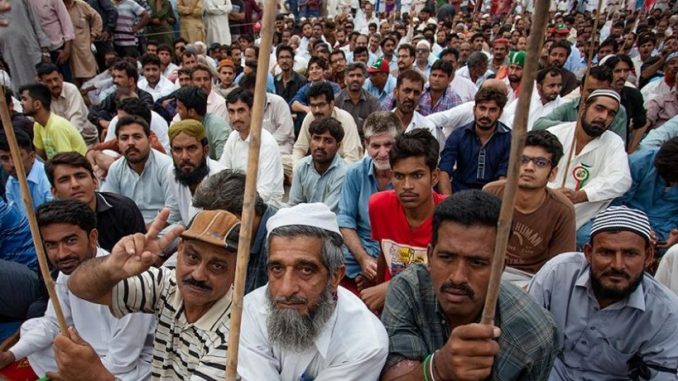
Taking up Rail Mazdoor Ittihad's call for a complete “stick in the wheel” strike, the 5 of August, all unions agreed to have a collective day of action on 5 of August. on this day, along with the “stick in the wheel” strike of railway workers across Pakistan, employees will close state offices and all airport services will stop. A protest will be observed in each state office. This is an important step in the recent history of Pakistan, since it expresses the mood of the working class. After the movement of 2007-08, which was democratically liquidated by the Pakistan People's Party government, Once again the working class movement is on the surface and is being discussed on the media agenda. We believe that this collective action by the working class will advance the movement, will leave an eternal impact on the labor movement and pave the way for the socialist transformation of society.