
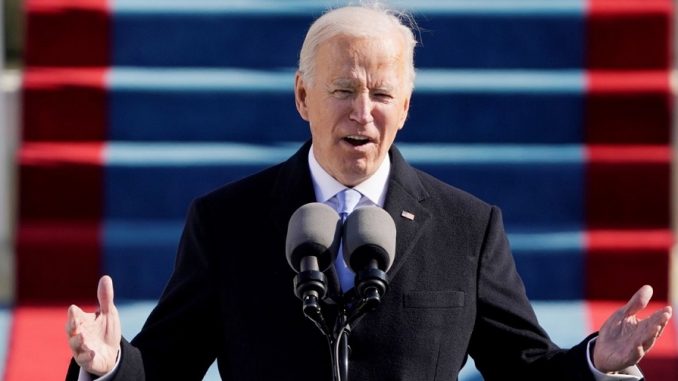
Biden assumes the US presidency: Analysis and perspectives
By: Luis Meiners
The change of command ceremony took place in a city prepared as a war zone. Checkpoints, bars and a troop deployment greater than the military presence in Afghanistan and Iraq combined. pandemic, Besides, added a reduced audience to the image and replaced it with flags and scenery. Trump did not participate in the ceremony, and left the White House in the early hours of the morning. An event that condenses the contradictions of the political moment in which it takes place.
In the situation marked by the assault on the Capitol two weeks ago, The ceremony was presented as a “turning of the page”, a moment of “national unity”. This was the central axis of the new president's inaugural speech.. This snapshot is a reflection of a moment in which the establishment has closed ranks behind the defense of institutions and the desire for stability of the ruling class..
The media has presented the inauguration as a defining moment, at the height of 1861 O 1865 in the context of the Civil War, O 1945 at the close of World War II. But, what can we expect, beyond the photo of the day? What tasks does the new government have ahead of it and what conditions is it in?? What challenges and debates does it present for the left?? This article attempts to address some of these elements..
Stability at home
The following quotes the CEO of a major corporation ina recent New York Times article synthesizes what they see as the task of the moment: “We need to stabilize. We need certainty. If we can't unite, if we cannot stabilize, or if things get worse, “It wouldn’t be good for business.” These words reflect the fatigue of the bourgeoisie with the instability associated with the Trump presidency, whom they had tolerated despite not being their candidate in 2016 and whose tax cuts they had celebrated. But the assault on the Capitol was too much. The National Association of Manufacturers, Chamber of Commerce, and other representatives of the business community condemned the events. It was a breaking moment..
Biden will seek to restore stability, and restore the legitimacy of the institutions of bourgeois democracy. The inauguration ceremony has been at the service of projecting that image. Forward, will seek to build a bipartisan consensus, working closely with sectors of the Republican party that have distanced themselves from Trump. Mitch McConnel's recent statements, Republican Senate President, blaming Trump for the events at the Capitol, show that there is openness in sectors of a divided Republican Party for this bipartisan strategy of “national unity”.
An issue that must urgently address the crisis unleashed by the pandemic and aggravated by Trump's criminal denialism. To this end, Biden has announced that he will send a rescue package to Congress 1.9 billions of dollars. This contains checks for direct assistance for the pandemic. 1400 Dollars, the extension of unemployment benefits and their increase to $400 (They are currently in $300, after completing its increase to $600), assistance for small and medium businesses, and funds for school reopening, mass vaccination and assistance to states and municipalities. There is a consensus among the ruling class and the establishment that getting out of the crisis will require spending. But this does not mean that there will be no austerity. The announced package is far from having the magnitude of Roosevelt's “New Deal”, as some of his leftist apologists have presented. It will provide oxygen to a battered economy, and not for too long. The increase in the deficit at different levels of the state, without any reform that alters an extremely favorable tax system for the rich, implies sharp cuts sooner rather than later. Some are already developing at the local and state level.
Added to this will be a series of decrees that will reverse some of Trump's most irritating measures., a clear change of style, a cabinet with diversity, and the promise to send reforms to Congress on issues such as immigration. Nevertheless, These must go through a tied Senate, and the commitment to bipartisan work that will surely limit the real scope of the measures.
Recover “leadership”
The other key task for Biden is to reaffirm the imperialist hegemony of the United States. To the decline of recent decades, with the bog down in endless wars in the Middle East, and the sustained rise of China, Added to this was Trump's international policy that weakened relations with allies and the multilateral institutions through which the US exercises its hegemony.. As Biden himself wrote in the influential magazineForeign Policy: “The next president will have to save our reputation, rebuild trust in our leadership, and mobilize our country and our allies quickly to meet new challenges.”
Biden's promise to restore US leadership in the world is completely in line with the concerns expressed by the National Security apparatus. It clearly reflects both the understanding that the United States must face a world of greater instability and inter-imperialist competition and the awareness that its relative weakness means that it cannot do it alone.. Because, seeks to leave behind the unilateral “America First” approach, regain their footing with their traditional allies to form a solid base to “get tough” with new and old rivals on the world stage.
The conditions
Synthesizing, We can say that the main tasks facing the new government are the restoration of stability, “business as usual” for capital, and the legitimacy of the institutions, Y, at the international level, the reaffirmation of imperialist hegemony. In a sense it is about turning back the clock four years and picking up the thread of Obama's presidency. But that's hardly enough..
First, because the very conditions of 2016 contained the fundamental elements that were deployed during the following four years. Trump was not a “black swan”, an unpredictable event. His presidency was the product of a growing political and social polarization that has its roots in the crisis of 2008 what, at the same time, expressed the exhaustion of an accumulation model, of an imperial hegemony and an institutional order. These combined crises will not disappear with Trump's departure from the White House.
Secondly, because new elements have been added to these conditions and previous trends have become more acute.. The pandemic was the trigger for an economic and health crisis that has had a particular impact on the United States., where the mark of the 400 thousand deaths. The economy suffered a sharp decline and the recovery seen in the third quarter of 2020 has slowed down. In December unemployment rose again, and the data revealed a drop in consumption. In this frame, Competition with rivals like China intensifies, that have emerged relatively strengthened from the last year.
The polarization and radicalization of the last decade has had a marked prominence in the last period. The immense rebellion against racism and police violence mobilized millions for months in 2020. Its effects will continue to be felt, as they did in Trump's electoral defeat. Biden will take office with a mass movement that has not been defeated, and that constitutes a strong condition on their room for maneuver. In the other side, the far right has become bolder during Trump's presidency. From Charlottesville in 2017 until the assault on the capitol, appears as an actor on the national stage who will remain relevant in the coming period.
All these elements combine and act as conditions for Biden's presidency and explain the structural weaknesses he will have to carry out his program.. Even though in the current situation he may be strengthened by “national unity” and the closing of the ranks of the establishment behind his figure to turn the page. These structural weaknesses will set the pace for the next period and will become increasingly visible as the smokescreen of the transition dissipates..
Challenges, opportunities and debates on the left
The political scene, for everything said above, It is marked by a series of combined crises and a government and a regime with structural weaknesses to confront them.. This means that, beyond the situation, political instability, polarization and radicalization will continue to be fundamental elements in the coming period. This opens up important opportunities and challenges for the left..
As we have seen in recent weeks, the extreme right will continue to be a relevant actor. Although numerically small, They have the capacity to carry out actions with national visibility. At the juncture, The assault on the Capitol has put them on the defensive and isolated them, but it also becomes a propaganda event that emboldens them and strengthens their recruiting capacity.. Faced with a government that will not resolve the structural causes that fuel its development, the extreme right will continue to grow.
This poses a challenge to the left. Conditions exist for the development of an independent socialist alternative, The anti-racist rebellion gives ample evidence of this. But a substantial part of the left goes in the opposite direction. After the assault on the Capitol, Bernie Sanders and Alexandria Ocasio Cortez appeared as defenders of institutionality. They line up behind the Biden government and the Democratic Party to “defend democracy”. The left could play a fundamental role in the situation, calling for massive mobilizations against Trump, the extreme right and the proto-fascists, from an independent position to “institutionality” and the Democratic Party. There are conditions for this.
Before the Biden presidency, It is urgent that the left appear as an independent alternative on the national stage, confronting both the far right and the Biden government. If not, will contribute to polarizing the political scene between the government and right-wing initiatives. The danger is great, but the opportunities too. Without a doubt, they will be fundamental moments for the development of the left in the US..