Peru: no beds or supplies
By: Alberto Giovanelli
As we have already reported, Peru is going through a strong political crisis, with a transitional government established after the fall of two leaders in the space of a week in mid-November. Added to this is the health crisis exacerbated by the arrival of the "second wave" of Covid 19 and an accelerated deterioration of the already critical and weak economy of the Andean countries, which provokes protests from different sectors: from that of agricultural workers against laws inherited from Fujimorism, even that of health system workers, Tired of being on the front lines without the proper equipment, inputs and fair remuneration.
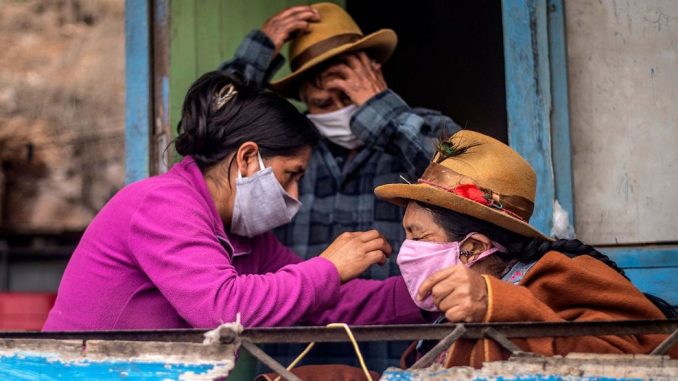
Peru has been one of the global epicenters of the pandemic and the Latin American country with the worst data: its coronavirus mortality rate is the highest in the region in relation to its population.
Now, while waiting for the arrival of the first vaccines from the Chinese laboratory Sinopharm, scheduled for the end of January, We are in the initial stage of the second wave of SARS-CoV-2 infections, that has already left more than 1.078.675 confirmed cases and close to 39.160 deceased, according to official figures, recorded at the end of the third week of the current month of January.
The health drama and the economic disaster have left millions of families in a serious situation and without resources to face it.
In the meantime, the Medical College of Peru (CMP) warned this last Sunday 24 January that the new wave of coronavirus that is hitting the country "has devastated the health system" and "is almost uncontrollable".
The professionals who have made the Government aware of the difficult situation facing the Peruvian health system stand out. The situation "is on the verge of becoming uncontrollable" they reaffirm.
In that sense, They criticized the "clear weakness" that the current Government and the Ministry of Health have shown, whose measures to confront the advance of the pandemic have been "lukewarm and timid."
They defended, Besides, the need to "put human life before the economy", and have proposed imposing focused quarantines in those districts with the highest incidence of the pandemic.
Additionally, about a dozen doctors from the national social security union have been protesting in front of the Peruvian Ministry of Labor., where they started a hunger strike last Tuesday. They demand more investments in the health sector and reject the management of the pandemic that is being done in the country, according to a statement from the National Social Security Medical Union of Peru (SINAMMSOP) .
These expressions join the numerous protests in different parts of the country. Doctors and other health workers are demanding more medical equipment, salary adjustment and an “increase in the budget for the health sector”. They claim: «Our ICUs are collapsing and we are not receiving any response and we are seeing the indifference of a government that assigns us the budget. "The Peruvian State has the constitutional obligation to guarantee the accessibility of health services and right now they are denying access to hospitals because we no longer have the capacity to provide patients with what they need so much.".
These are the reasons why a significant increase in the budget for the health sector is urgently needed.. We must stop the adjustment of the sector now. Let us demand that all necessary resources be used to improve public hospitals, the laboratories, ICU beds, and everything necessary to be able to provide a truly essential service.
As we have repeatedly denounced, during the previous phase of the pandemic, that is to say, During the first wave, mass testing was insufficient and of very low quality. For that reason, Today it is urgent to implement a massive campaign of free molecular testing that reaches the entire population.
Also the increase in salaries, The appointment of new professionals and an analysis of the infrastructure by workers will be essential, and to do this we must suspend the payment of the public debt and apply heavy taxes to wealth to obtain the resources that allow us to implement these tasks..