Sweden: first conclusions about the elections
Writes: Sergio Galarce
The final results of the tight vote of the 11 of September will be known on Wednesday 14, giving way to the formation of the new government, that could be right. It will take “one foot in parliament and a thousand feet in the streets and squares”.
The deep economic crisis, social and military crisis that the capitalist system is going through worldwide and its administration in the hands of bourgeois or social democratic parties does not necessarily lead to a shift to the left when there are elections. This has been demonstrated in Sweden this 11 of September.
Provisional count results
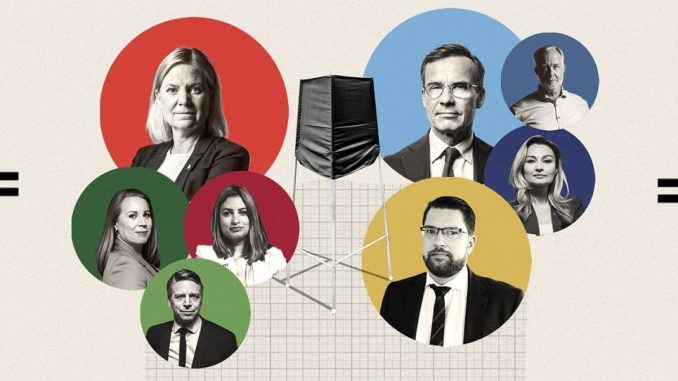
Social Democracy obtained a 30,5%, This is an increase of one 2,2% in relation to the elections of 2018, the extreme right (The Sweden Democrats) a 20,6% with which a 3,1% in respect of 2018, the Conservatives (The moderates) with a 19,1% which leads them to decrease in a 0,7%, the party of the agrarian bourgeoisie (The Center Party) gets a 6,7% with which he goes back a 1,9%. The Greens (The Green Party) they get a 5,0% which means an increase of one 0,6%, the Left Party (The left party) achieve a 6,6% of the total vote with what goes back in a 1,4%. The Christian Democrats (The crisis democrats) a 5,4% which translate into a decrease in 0,9% and finally the liberal party with a 4,6% and also a retreat of 0,9%.
Social democracy and the consequences of its politics
capitalist crisis, fueled by an ongoing war and consequent militarism, has brought with it, among other things, rising inflation at European level. The neoliberal policy implemented in Sweden by social democracy in collaboration with sectors of the right during these last four years has further paved the advance of the extreme right. It is a trend to which almost all right-wing parties and social democracy have adapted..
Xenophobic and chauvinist speeches
For its part, the mass media has long fueled the “radical” role of the extreme right.. Since neither the right nor the social democracy can point to the permanent crisis of capitalism as the root of the existing problems, they have to look for a scapegoat and here appear the immigrants who have been linked to the existing crime.. This undoubtedly favored the xenophobic card of racism.
The fact that the extreme right attacks immigrants is not new in Europe. Added to the xenophobia of the extreme right was the chauvinist patriotism that in these elections has encompassed almost all political parties.. This was clear for more than a year and was strongly deepened at the end of the electoral campaign., when the right and social democracy competed like crazy for who presented the most aberrant proposals against racialized people. This led the extreme right to strengthen its populism and xenophobia.
The Vänsterpartiet adaptation
It is strange that in a field like this only Annie Lööf (the leader of the bourgeois agrarian party) raise an anti-racist profile, but maintaining an economic policy against the interests of the workers. It could be said that it is also strange that Vänssterpartiet has not started from this reality to strongly raise the banner of anti-racism from the beginning of the electoral campaign.. Nevertheless, the latter is not so strange. At the pre-electoral congress, where the party's electoral line was defined, Vänsterpartiet management opposed raising a clearly anti-racist profile, despite everything indicating that the right sought to capitalize on immigration policy. to give way to the People's Constitution, central issues voted on by the pre-electoral congress were ignored in favor of an orientation towards the most depopulated and remote areas of the cities and towards industry to try to attract the vote of men whose discontent with the current state of things led them to see an alternative in the populist extreme right.. This explains why Vänsterpartiet adapted to it and did not have a clearly anti-racist and environmentalist profile, which led it to blur its own ecological left identity.The left partyIt therefore did not have a line for important sectors of immigrant workers or with bakgrund in immigration, who today constitute a considerable part of the modern working class. That objective failed and did not contribute to surpassing Centerpartiet in votes. This partly explains the electoral setback (1,4%) of Vänsterpartiet in these elections compared to the elections of 1918.
Reactionary forces could form government
The clear winner in these elections is the extreme right that raised the chauvinist and racist flag. Formally, there was almost a tie between two “blocs” and the right will be able to form a government with the support of the extreme right., which in itself is very serious. And this despite the fact that the liberal party promised during the campaign that it would not contribute its seats so that the extreme right could play a decisive role in the budgets of a right-wing government.. But the important thing is that the advance of the extreme right, that delayed almost the entire political spectrum, objectively strengthens the reactionary forces and most likely this will be crowned with a new victory of post-fascism in Italy, where the vote will be held on sunday 25 of September.
100% left, there is no room for half measures
The positive thing is that the progressive forces, and in particular the adherents of Vänsterpartiet, made significant progress in Sweden's three largest cities – Stockholm, Gothenburg and Malmö. If we look at it from a class point of view, The left now faces the task of organizing resistance to the renewed offensive of the bourgeoisie and its new government.. Here the task of the left must be to transform itself into a left 100% left. There is no room for half measures, the left must start from the needs of the entire working class, of climate change, of anti-racism and the strengthening of feminism and social movements, which means assuming a consistently socialist and internationalist stance. That can be summarized as follows: one foot in parliament and a thousand feet in the streets and squares.