U.S: The end of the Sanders campaign and the need for strategic discussions
By Luis Meiners – READ US
He 8 April Bernie Sanders announced the end of his campaign and a few days later he made a public video call with Joe Biden announcing his support for the latter, who is now in fact the candidate of the Democratic Party for the presidential elections in November. The end of a presidential race that marked the last 5 years of American politics opens important debates within the left around strategy and tactics for socialists in the United States. In this article we want to make a first contribution to these.
After a promising start for Sanders in the first primaries of the year, including a resounding victory in the state of Nevada, the democratic establishment closed ranks behind Biden. After Super Tuesday, his path to the nomination was practically closed. With the Covid19 crisis advancing, the pressure of regime for Sanders to lower his candidacy and pave the way for Biden was on the rise. Until he finally gave in. Sanders' candidacy comes to an end when the crisis triggered by the Covid19 pandemic shakes the foundations of the US. Paradoxically, ends when your proposals, like him universal health insurance, acquire increasing relevance and social support.
This result reminds us of what happened in 2016. Nevertheless, its effects on the debates within the left are greater than they were ago 4 years. At that time, the horizon of the elections 2020 which Sanders could reach with greater recognition, structure and financing, covered strategic debates with a perspective of quick results. Given the current absence of this perspective, debates become urgent.
Sanders y el establishment
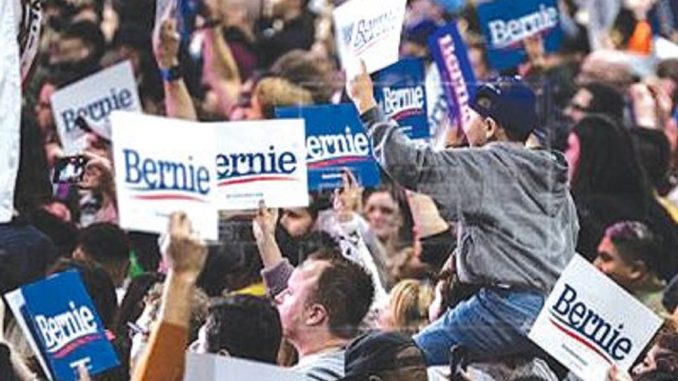
The call to a political revolution along with an economic program that called for reforms Popular economics made the Sanders campaign a platform under which the hopes of many for structural change were gathered. reflected and expressed a mood of political radicalization provoked by the crisis of 2008 and the relative rise of class struggle and social movements massive ones that followed.
Nevertheless, always had clear limits. The most important is the fact that it developed through the Democratic Party. This is not an abstract debate, but one with clear consequences that have re-emerged since Sanders left the career. A campaign is not in itself a movement. This requires a independent structure, organized and democratic. The lack of a match independent meant that none of this was guaranteed. This has been done evident with Sanders' decision to drop out of the race and endorse Biden. The movement was not called to discuss any of these decisions, nor the steps to follow.
But it is not just a matter of democratic debate. The Democratic Party cannot be transformed in a vehicle of progressive social change. It is deeply rooted in the ruling class, of which his political establishment is part. That's why was so willing to close ranks behind a neoliberal candidate and accused of abuse, which also does not arouse enthusiasm, in order to cut off the passage of Sanders.
The strategy Sanders' "realignment", that is to say, try to push Democratic Party to the left and, ultimately capture it, it is not just a dead end. It inevitably leads to a path of adaptation to the logic imposed by the democrats, such as calls for moderation and "party unity". This explains why Sanders gave in to the growing pressures to drop out of the race and back Biden. And why then He has openly criticized those who will not follow him on this path. In doing so, adapts to the logic of the “lesser evil” pushed by the Democrats. About this, Antonio Gramsci said: “The concept of "lesser evil" or "less worse" is one of the most relative. (…) Every evil is minor compared to another that is announced greater and so on to infinity. The formula of the lesser evil, least worst, it is not but the form that the process of adaptation to a movement historically assumes regressive”.[1]
Triumphalism, defeat and turn to the right
The political evolution on the part of the left has run parallel to this process. After the victory in Nevada, Jacobin magazine (linked to the DSA and the current Bread and Roses) published a note that triumphantly proclaimed “Now it is Bernie's Party[2] in reference to the democrats. Its authors analyzed how the campaign Sanders was building a coalition strong enough to defeat Biden and win the presidency.
This postulate had a clear conclusion: there's no need, nor desirable in the present, build a political party independent of the Democrats. A) Yes, the “dirty break” policy (dirty breakup), was giving way to the idea of “surrogate party” (substitute match). The first argued support for the Sanders candidacy (and in general the use of the Democratic ballot) like a tool to organize the critical mass necessary for the construction of a working class political party, with the break with the Democrats in a near horizon (although in some of its versions, postponed to a uncertain future). The “substitute party” line, instead, emphasizes that energy must focus the task of nominating candidates using the Democratic Party ticket, with an auxiliary organization “independent” structured for this task, Instead of consolidating a third party with its own identity and structure.
The defeat of Super Tuesday deepened this conception even though the weight of Democratic establishment showed the limits of a focused strategy exclusively in nominating candidates through their ballot. Dustin Guastella, one of its main spokespersons, presented as guidance: “post-Bernie organizations They need to combine their efforts and unite around certain careers state legislative and congressional efforts to begin building a true bloc of legislators. This is feasible, but it requires rejecting the fantasy of that now is the time when we all throw ourselves into the work of building a third party or militant protest activity (…) The Democratic ticket gives us legitimacy and access to a mass base, and we cannot afford abandon the tactic of using it because we are angry with the party.”[3]
The orientation, so, is to conquer legislative spaces. For this it is necessary to abandon the construction of a party independent of the democrats, and avoid “launching into militant protest activity”. It is not from It is surprising that this note ends up calling to focus on a program of immediate economic demands, abandoning the most radical aspects.
The end of Bernie's campaign deepens these debates. The general approach present in different balances published by Jacobin can be summarized in expressions such as “not “We have the strength to stop using the Democratic ticket in the near future.”[4], and orientation proposals focused on electing “new Bernies” to Congress and the senate, using of course the Democratic ticket, to be able to return to contest electorally at the national level in some 20 years. Connor Kilpatrick, argues that there should be the hopes of the movement and not in “crazy schemes of apocalyptic ruptures.”[5]
These debates have deep roots. Its political conclusions follow from theoretical and strategic positions. It is no coincidence that much of this has been preceded by a theoretical-political “revival” of Kautsky. They defend the idea that in “advanced capitalist democracies” a social revolution is not part of the horizon of possibility, and the fight for socialism will take the form of a succession of partial democratic ruptures that combine electoral victories with mobilization to defend the reforms that these governments promote.
Views From this framework, elections are a strategic terrain. This leads to all politics is ordered by the possibility of winning. And all the calculations they do based on that. Completely ignoring class power structures that are part of the DNA of the capitalist state. The electoral success, far from be turned organizationally to build an independent structure and transform that energy into a force that is expressed in all areas of life. organized class struggle, It is seen as a path to power, and always ends up requiring a series of political-programmatic adaptations to the right in order to win the greatest number of votes. The History has shown where this ends.
Crisis, opportunity and strategy
The pandemic and The economic crisis has changed the concrete life experience of millions of people. people. We have witnessed a growing cycle of protests that have the working class as the central protagonist. We can expect these changes to have a profound and sustained impact about class struggle. The tendency towards social and political polarization of the last decade will increase and we will see radicalization and fights.
In this
scenario strategic debates are central. Just as our horizon does not
may be marked by the electoral calendar and the Democratic Party, neither
we can draw the conclusion that every electoral tactic is opposed to
strategic construction. The revolutionary left cannot either
relate to the thousands who placed expectations on Sanders saying "you'll have it"
I said”. Thousands of those who today lead the fight against the crisis supported and
They even actively participated in the Sanders campaign. Many others do not.
Both are fundamental parts of a political construction.
strategy that lays the foundations for a working class party. This
It is the task of the moment and it cannot continue to be postponed..
[1] A. Gramsci, Notebooks of the Jail, Notebook 16 (XXII)
[2] https://jacobinmag.com/2020/02/bernie-sanders-nevada-caucus-democratic-primary-win
[3] Where Do We Go After Last Night’s Defeat? By Dustin Guastella. Published in Jacobin. https://jacobinmag.com/2020/03/bernie-sanders-democratic-primary-results-joe-biden
[4] Bernie Supporters, don´t give up! By Eric Blanc. Published in Jacobin https://jacobinmag.com/2020/4/bernie-sanders-campaign-supporters-2020
[5] We lost the battle, but we´ll win the war. By Connor Kilpatrick. Published in Jacobin. https://www.jacobinmag.com/2020/04/bernie-sanders-presidential-campaign-democratic-socialism