
U.S: Evaluating the choice of 2020. Where do we go from here?
As a contribution to the analysis of the elections in the US and the tasks of the left, Below we reproduce an article written by Aaron Amaral and Phil Gasper, originally published inTempest.
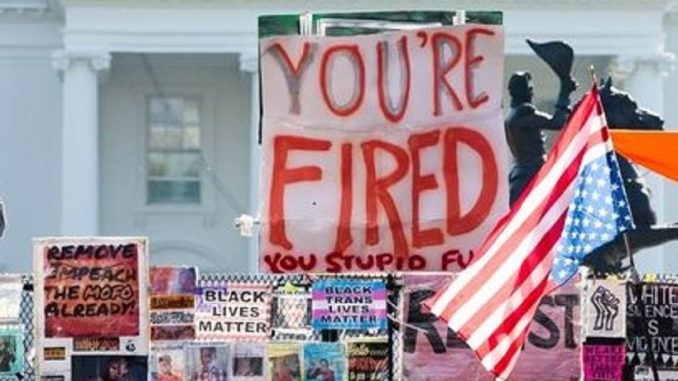
A satirical headline from the day after the presidential election captures the sentiment of much of the left: «Jubilant reaction to Trump's defeat, quickly embittered by the news of Biden's victory".
We take for granted that the defeat of Donald Trump—a misogynist and white supremacist, fragile and pathological solipsist, wannabe authoritarian and scammer, and immediate destroyer of hundreds of thousands of lives—is cause for celebration. Nevertheless, the political landscape that the left is collectively entering after the 20 January will be incredibly challenging, and some of the damage we have suffered is to some extent self-inflicted.
The results
Considering Trump's Historically Low Popularity Ratings, his disastrous handling of COVID-19, strong support for the Black Lives Matter movement and Democrats' huge fundraising advantage, should have been a landslide victory for Biden. Instead, scraped by. Biden has a lead of about a 3,4 percent of the popular vote, but Trump increased his vote pool by more than 9 million compared to 2016. And the margins in the most contested states that Biden managed to turn (Pennsylvania, Michigan, Wisconsin and probably Arizona and Georgia) They were very fine.
Take the example of Wisconsin. In 2012 Obama won the state by about a quarter of a million votes.. Trump's margin in 2016 it was of 23.000 votes. Biden won by 20.000, which is not a resounding victory. The key to Clinton's defeat in 2016 was that participation in Milwaukee, particularly among African Americans, was low, and that reality remained this year. In 2016, could be attributed in part to misogyny and voter suppression, but the main factor was that Clinton's centrist politics offered nothing to vote for.
That was even more true with Biden, who defined himself by the negative in a series of elements. He was not in favor of Medicare for all, ni del Green New Deal, nor defund the police, he was not a socialist, and most importantly, no era Donald Trump. His main positive messages were technocratic and restorationist.. In addition to promising competent management of the COVID-19 crisis, The Biden-Harris campaign was defined by the promise to return to politics (neoliberal) business as usual and a return to imperial normality. Biden and his campaign built a coalition made up of so-called moderate Republicans, the national security state apparatus, the Pentagon generals, sections of the big capital and some of the more affluent parts of the middle class.
In voters who considered COVID-19 to be the main problem, exit polls showed a preference for Biden by a wide margin, but the counties that have suffered the most COVID-19 deaths voted overwhelmingly for Trump. A dynamic could also be seen that has been at play at the international level as well., expressed in support for Trump from a base of small business owners, a precarious lower middle class, which has faced an existential threat from the shutdown of the economy. Voters who considered the economy the main issue preferred Trump. This was despite living through a seven-month period in which the United States experienced an economic contraction and unemployment rates comparable only to the Great Depression., and in some cases worse.
Biden's campaign strategy was to stay out of sight, say as little as possible, reduce expectations and rely on hatred of Trump. Given Biden's notorious weaknesses as a candidate, It could be said that this was the optimal strategy for him, and took it to the finish line, narrowly.
Biden's Democrats
In addition to the presidential race, Democrats hoped to increase their majority in the House of Representatives and flip the Senate. For comparison, Obama's victory after the financial crisis 2008 occurred with a net increase of 28 seats in the House and 8 seats in the senate. This time, instead, the democrats have lost so far 5 net seats in the House. To regain the Senate they need to win the two January special elections in Georgia, which seems unlikely.
Biden ran as the establishment candidate, anti-Bernie Sanders, and in his defeat of Sanders, he was able to drag the entire left of the party behind him. Sanders' defeat was a blow to illusions about the possibility of reforming and realigning the Democratic Party. Despite the poor performance of Biden-Harris, His victory as a formula for national unity of the center seems to have paralyzed the left of the party, whose room for maneuver in the context of a divided government is limited.
Despite the left's almost complete capitulation to Biden-Harris, The leadership of the Democratic Party has embarked on a campaign to attack the left of the party. South Carolina Representative, Jim Clyburn, the governor of new york, Andrew Cuomo, and the party strategist, James Carville, They took turns blaming the left for the poor election results. A New York Times interview with Alexandria Ocasio-Cortez (AOC) offered little comfort. While adequately defending the movement for Black lives and denouncing the hostile environment within the Democratic Party and the failures of its campaign strategies, AOC's own pessimism was palpable. Corporate Democrats appear to have firm control of their party.
The electoral campaign, The current situation within the Democratic Party and the likely composition of Congress mean that if expectations for the Biden administration's policies were low before, They should be even lower now. Even the minor reforms that Biden does support, like a slightly more progressive tax structure, They are unlikely to be approved in the Senate.
Biden will rejoin the World Health Organization and the Paris Climate Agreement. He will restore DACA and reverse many of the executive orders and other symptoms of chaos that will be Trump's gift when he leaves the White House. And given big business demands for more economic stimulus, there may be modest immediate relief for the unemployed and another round of one-time direct payments. But, in the absence of mass movements in the streets, there will be no more than that.
In the meantime, The economic fundamentals and context of an ongoing public health crisis, especially for nearly bankrupt state and local governments, They are a bad omen for the medium and long term..
trumpism, the Republican Party and the extreme right
One reality that will endure is that Trump has succeeded in turning the Republican Party into a hard-right organization.. A recent study concluded that it is “more similar to autocratic ruling parties such as the [Justice and Development Party] Turkish and Fidesz in Hungary than to the typical center-right ruling parties in democracies such as the Conservatives in the United Kingdom or [the Christian Democratic Union] in Germany «. The study ranked the Republican Party also to the right of the current incarnation of the National Front in France..
Another reality is that Trump has encouraged the growth of the fascist right in the streets. Their number is still relatively small, but they constitute a growing threat. This includes the active infiltration and ideological leanings of local and state police forces., and the use of sections of the federal Homeland Security apparatus as presidential goon squads. Biden should not be expected to address any of this without an active movement to force him to do so..
Finally, regardless of its innumerable weaknesses, Trump has fanatical personal followers. The coalition that elected him in 2016 largely stuck with him, and even extended it, gaining additional support from African Americans and Latinos.
It would be absolutely reductionist, and completely wrong, classify the most 72 millions of Trump voters as troops of fascism. But there is an absence of a real alternative from the left. And the Democratic Party is apparently committed to triangulation, avoiding any substantive confrontation with central right-wing politics while remaining the hated party of the neoliberal establishment. The danger is that these voters become even closer to the reactionary and harmful politics of Trumpism.
Trumpism is definitely not going away and, in fact, Trump himself may not go away. The idea that he had enough support to somehow steal this election was always more of a liberal scare tactic than a reality.. But Trump can use his Twitter account and continued rallies to attack Biden and will try to remain the leader of the Republicans once he is out of office.. He is already floating the idea of another run for the White House in 2024.
The election took place within the framework of the crisis of neoliberalism, that has defined American politics since the financial collapse of 2008. It is an ongoing crisis for both the ruling class and the working class, but in very different ways. For the ruling class, The crisis is about how to restore profitability and maintain imperial dominance, particularly in an accelerating conflict with China. For the working class, It is a growing poverty crisis., Declining living standards and increased state repression.
This, Of course, is what is behind political polarization not only in the United States, but in much of the rest of the world. The bipartisan consensus that reigned for more than 30 years it no longer works. The Republicans have realized this and, so, have moved to the right.
Centrist Democrats like Biden, whose political career was shaped by the ancient consensus, They think they can turn back the clock, that's a fantasy. Democratic centrists have only managed to marginalize the left of their own party. If you continue down this path, his perspectives for the 2022 Y 2024 they don't look good. Without significant advances from the left and social movements, the right is ready to advance.
The self-inflicted wounds of the left. Results and Prospects
So, What are the prospects for the left and social movements?
This past summer's multiracial Black Lives Matter protests were historic in both size (more of 23 millions) as in scope (2000 cities and towns in all fifty states and five territories). The conditions that gave rise to this uprising are not, Regrettably, disappearing. Nor will the experience of the last decade be soon forgotten. (and more), including broken promises from the Obama-Biden administration, that brought so many to the streets. Nevertheless, The decline in activism in the months leading up to the election was notable and the lack of meaningful national organization is a challenge we will have to overcome.
In the same way, the fearful silence of sectors of the feminist movement during an election in which both candidates were credibly accused of sexual assault, It's part of what leaves this movement in a weakened state.. This damage has been done just when feminism is on the rise worldwide.; and when the fight for bodily autonomy is about to face—with the Supreme Court on the right—an incredible fight.
and the labor movement, both inside and outside the unions, has a contradictory appearance. We have seen a rise in working class militancy, dating back to the teachers' strikes and revolts, and the beginning of broader organizing efforts among the unemployed, precarious and the undocumented immigrant workforce. At the same time, nearly forty percent of union voters supported Trump in key states. Meanwhile, AFL-CIO leadership appears committed to completing its apparent task of following the Democratic Party into effective oblivion.
Regarding the socialist left, We have to look at where we were in the run-up to these elections and where it has left us. The dynamic on the left in the United States in recent years has been one of unprecedented numerical growth, con Democratic Socialists of America (DSA) expanding from 6,000 members before 2016 to something close to 80,000 current members. This is part of an international process of radicalization and political polarization that has roots, as noted above, that go back to 2008.
In United States, for understandable reasons, the political expression of radicalization took shape in support of Bernie Sanders, AOC, and other electoral campaigns. But the reformist conclusions that many drew from this—that the left's strategic priority should be electoral and that the left can "build power" using the Democratic Party—are, in our opinion, wrong. The pursuit of this strategy has left a large part of the socialist movement without a compass and without a viable plan for the next period..
But the DSA is not a monolithic organization. Within it there are debates about the role of Democrats and the role of electoral politics in general. Many DSA members agree that the working class needs its own political party. Some defend something called the “dirty breakup.”: use the Democratic Party ballot to participate in the elections now with the goal of eventually creating an independent political party. The problem with this is that as the breakup is postponed to the distant future, approach has become indistinguishable from that of the desperate task of trying to transform the Democratic Party itself..
Nevertheless, Even more fundamental than a discussion of the “dirty breakup” is the question of the role of elections in social change.. The historical record is quite clear on this point. Radical, progressive change always requires powerful social movements that make the cost of keeping things as they are too high for the ruling class.. In the decade of 1930, marches for unemployment assistance, the bread riots, spontaneous strikes, a massive movement against evictions and other outbreaks, often led by communists and socialists, pushed President Roosevelt and the Democrats to enact New Deal reforms. In the decade of 1960, civil rights movements, Black liberation, pacifist, feminist, gay and environmental liberation, won a new series of reforms, which continued even under the Nixon administration.
None of this means that elections are not important., but if our goal is to fundamentally change the nature of our world, Electoral campaigns must represent social movements with the aim of strengthening them. At least, They must promote and defend the demands raised by social movements, like the one that emerged this summer to defund the police. Historically, the DSA has not prioritized the political struggle outside the electoral sphere. But a new generation of socialists recognizes that democracy is much more than elections. When Black Lives Matter protests erupted across the country this summer, many DSA members participated as individuals or as members of local branches. The Caucus of Afrosocialists and Socialists of Color played an especially important role. Unfortunately, The national leadership of the DSA did not attempt to guide the entire organization to advance this fight.
Of course, This is far from a closed topic.. The anti-racist struggle for abolition has not gone away, and movements sparked by a whole range of other issues will be inevitable in the months and years to come.. Socialists both inside and outside the DSA must argue that the incoming Biden administration should not be supported and that the left should throw itself into the political fight in the streets and in the workplace. We are not organizing ourselves under the conditions we choose, but the potential to rebuild a powerful left has not disappeared and it is more urgent than ever that we realize.