Syria. One less bloody dictator, an uncertain future
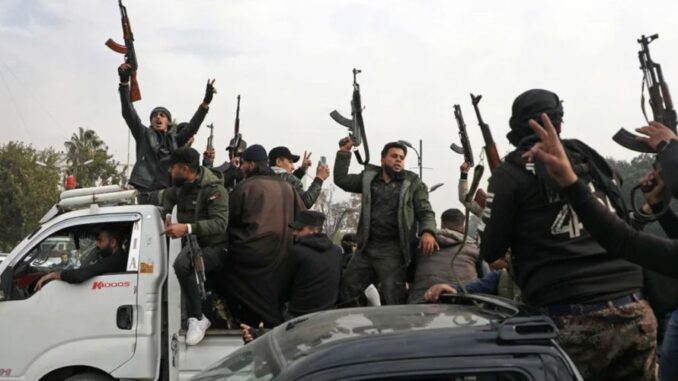
In a Middle East already severely devastated by the Palestinian genocide and the attack on Lebanon at the hands of the Zionist State of Israel, Bashar al-Assad's bloody dictatorship fell days ago in Syria, replaced in power by an Islamist sector in command of a heterogeneous rebel coalition. A new stage opens in the country and the region, full of questions.
A transcendent event. For the Syrian people and other Arab peoples in the region, This change represents a very important advance. They finish 54 years of dictatorial regime of the al-Assad clan: 24 years of deposed Bashar and 30 previous years of his father Hafez, through the Baath party. The regime, of a populist Arab nationalism, he turned more and more to the right, He negotiated with different imperialisms and, especially in recent decades, never significantly supported Palestinian resistance to Zionist colonialism and genocide. Unlike, In fact, he limited himself to verbally supporting the Palestinian cause and using it for internal oppression.. That is one of the reasons why many Palestinians, including Hamas, they welcomed the fall of al-Assad.
It should be noted that the Baath Party's rule in Syria began in mid- 1960 as a somewhat progressive and anti-imperialist project under the leadership of leaders like Saleh Jaded. But due to the lack of a Marxist leadership, the ideological confusions, zigzags and internal disputes, the party ended in a very corrupt clientelistic capitalism, that required unprecedented and permanent state repression of the vast majority of the population. The degeneration of the regime accelerated after the 1990s when it adopted pro-market neoliberal economic policies., which led to him losing the popular support he once enjoyed. Desertions in the Syrian army and the rebel victory in just ten days confirm that the regime was decomposing, no social support. No democratic solution could be opened with that corrupt tyranny at the service of the Assad clan and its figureheads in power.. That's why a crowd took to the streets to celebrate., in Syria and several other countries. It is that over a total population of 24 millions there are 5 millions of refugees outside, fleeing the civil war and the repression of 2011, who now began to return to their country.
Russia and Iran, beaten. For both countries, which have also been under dictatorial regimes for decades, The fall of al-Assad implies a very great weakening of his influence in the region. Both Putin's government and that of the Iranian mullahs were for years the fundamental political and military support of Syria. Russia's secret services, an emerging imperialism busy in its invasion and war against Ukraine, They did not foresee this rebel offensive in Syria. And the same goes for a very weakened Hezbollah and especially for the theocratic dictatorship of Iran., that instead of leading the anti-Zionist “axis of resistance” as he had promised, in fact he betrayed the Palestinian struggle. In any case, both Iran and itsproxies like Russia were no longer in a position to support a hollow regime that collapsed like a house of cards with the slightest push..
At the same time, Israel took advantage of the power vacuum these days to enter troops into the demilitarized zone between the Golan Heights - which it has illegally occupied since 1967- and Syria.
The diverse rebel alliance. Covers four sectors, sometimes pitted against each other:
- Committee for the Liberation of the Levant (Hayat Tahrir al-Sham, HTS): Sunni Islamist group that in recent years has tried to present itself as the main “moderate” force. Its political wing is the Syrian Salvation Government and its main leader is al-Chaara(aka al-Jolani).
- Syrian National Army (ENS): supported by Türkiye, joined the National Liberation Front and seeks to create a buffer zone on the Turkish border to prevent the advance of the Kurdistan struggle.
- Syrian Democratic Forces (FDS): Kurdish militias led by the Popular Protection Units (YPG), with US support, They control the Rojava area and suffer attacks from the ENS.
- Free Men of Syria (Ahrar al-Sham): arose in 2011 of the merger of several ultra-Islamist groups, with influence of the Afghan Taliban.
ISIS (Islamic State, Daesh) It is not part of this alliance because it is a rival of HTS, but it still exists and in the current crisis it could regain presence.
No to external interference. In 2011, as part of the Arab Spring, In Syria there was a popular rebellion against the dictatorship. Al-Assad repressed harshly and started a civil war that caused 600.000 dead - including more than 100.000 civilians- and ten million displaced, half internal and half external. Among the rebellious political and religious sectors, who at the beginning were more independent, US influence grew. and also from Türkiye, that will seek to maintain or expand it. further, the support of other reactionary states cannot be ignored, like Saudi Arabia, Qatar, Jordan and the United Arab Emirates, to various factions. Such is the complexity of the situation., that these powers can be allied in one part of the country while facing each other in another.
In this days, HTS negotiates with UN envoy Geir Pedersen, former Assadist Prime Minister al-Jalali and representatives of other countries based on the Resolution 2254 of the United Nations Security Council, that proposes a “civil transition” of 18 months, a new Constitution and the call for elections. Nevertheless, the possibility of bloody infighting between rebel groups during the process cannot be ruled out.
What exit? The joy of large sectors of the Syrian people over the fall of the dictator cannot hide the existing risks. As we said, in the multiform rebel alliance there is imperialist influence, of the Turkish expansionist regime and Islamist sectors -including the HTS-, whose strategy is a theocratic State that is not going to guarantee the democratic and social rights so postponed. A true democratic solution should include the call for a free and sovereign Constituent Assembly, where returning refugees can also intervene, to reorganize the country on a course of national and social liberation, solidarity with the Palestinian cause and state secularism for peaceful coexistence between peoples and religions.
From the LIS we are committed to the development of a revolutionary anti-imperialist and anti-capitalist alternative, fighting for a socialist Syria within the framework of a socialist federation of the Middle East. We emphasize that this is only possible through the revolutionary organization of the working masses and the oppressed people of Syria., in alliance with the oppressed and exploited of the Middle East and beyond.
• Down with all imperialist interference in Syria
• Down with theocracy and religious fundamentalism
• No illusion in the forcesproxy and accomplices of imperialism
• The democratic aspirations of the Syrian masses must be respected
• Solidarity and support for the Syrian people, for a democratic Syria, secular and socialist
Coordination of the LIS
12 from December to 2024