
European Green Deal: environmental marketing and structural setbacks
Five years after its launch, The Green Deal of the European Union exhibits postponements, flexibilities and setbacks that expose the limits of an environmental policy subordinated to capitalist profit and geopolitical disputes.
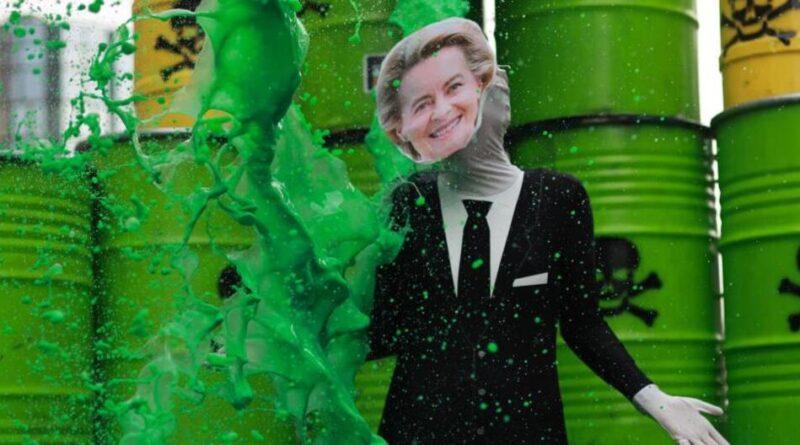
Since awareness about the destruction of the planet expanded among broad social sectors and active claims multiplied, the leaders of the European Union (EU) they have painted their faces green. They hold summits, conferences and project objectives to appear as defenders of environmental care.
In this frame, in december of 2019 the European Commission, chaired by Ursula von der Leyen, presented the Green Deal, which was ratified by the European Parliament in January 2020. The initiative declared the intention to turn Europe into the “first climate neutral continent by 2050”, decoupling economic growth from resource use. The main goal was set to reduce net greenhouse gas emissions by at least one 55% for 2030 (compared to the levels of 1990), through the “Goal 55” legislative package.
Although both the objectives and the measures, per se, They were partial and limited, His presentation was always bombastic and with strategic overtones. But let's see what has happened after five years of "execution".
Undeniable delays and setbacks
Public official information and some honest specialists have shown that the EU has made a series of significant setbacks in key areas of the Green Deal.. For example, withdrew and indefinitely stopped the proposal that sought to reduce by half the use of chemical pesticides for 2030. The Nature Restoration Law was first approved by Parliament and then blocked by several member states of the bloc (led by Hungary), which put its final ratification at risk and left its application postponed.
In the Agriculture and Emissions item, environmental requirements were eliminated from the Common Agricultural Policy (PAC), like the obligation to leave a 4% of fallow lands to promote biodiversity, and controls on crop rotation were relaxed. Regarding the Antideforestation Law, Postponements have been requested in the implementation of the rule that prohibits the import of products that cause deforestation, under the argument that bureaucracy is excessive for business partners. Regarding Air Quality, extensions were agreed that allow certain countries to delay compliance with new pollution limits for up to ten additional years (2040 rather 2030).
further, through one of the last decisions adopted in 2025, The veto on vehicles with combustion engines planned for 2035. Thus, Manufacturers will be able to continue selling a limited number of gasoline or diesel cars, a measure taken to protect the German automotive industry, lagging behind in electric mobility compared to China's leadership.
If you remember that Europe is the fastest warming continent on the planet, Both the impossibility of hiding these setbacks and the limited validity of the pretexts that supposedly justify them become evident..
Weakness in planning, superficiality in the causes
Given the failures of its environmental policy, The EU and national governments have tried a series of explanations that reveal the weakness of the original plans and the superficiality with which the causes for which the existence of the planet is threatened and are presented., Thus, of humanity itself as it currently exists.
They argue that excessive environmental restrictions could reduce agricultural production in a context of global instability; that regulations are too complex and expensive; that it is necessary to protect the competitiveness of the industry in the face of high energy prices; and that it is urgent to stop the farmers protests who blocked European capitals.
In a nutshell, supposedly they are only now “realizing” the implications of the policies that have them as protagonists: the inter-imperialist economic dispute, political and military for world hegemony; laws in favor of large multinational companies; and the drive for capitalist profits, to the detriment of farm workers and small agricultural producers.
These questions, originated in the field of production, They then move to distribution and marketing and, but still, to big cities, with higher prices and increasingly impoverished small producers. The working class also suffers, threatened with losing jobs and working conditions, when the costs of the transition have to be paid by employers.
Motivated by immediate interests
Beyond the official arguments, The analysis suggests conjunctural and structural political factors. The traditional parties, both social democrats and right, They adopted more conservative speeches and measures to try to avoid the flight of rural votes to the extreme right..
Other actors that took advantage of the social unrest to overthrow regulations that affected their profits were agroindustrial and chemical industry pressure groups., as well as those in the energy sector. These last, taking cover from the outbreak of the energy crisis derived from the break with Russia, They pushed to prioritize high-cost energy supply and even to return to coal use., beyond long-term decarbonization commitments.
The discourses of power thus veer from the priority drive for sustainability towards the defense and autonomy of capitalist production and profits., with the objective of overcoming the scope of the systemic crisis that began in 2008.
The underlying reasons and a strategic exit
The elements cited by the powerful do not explain the underlying causes why there are brakes and resistance to a decisive implementation of policies aimed at saving the planet.. As stated in the Document adopted by the Third Congress of the International Socialist League (LIS), titled “The challenge of our time: socio-environmental crisis, revolution and socialist transition: “The matrix of production and consumption subordinated to private profit, with its regime of private property of large corporations, with national borders that artificially divide the peoples of the world, and its consequences in socio-environmental matters place human civilization as we know it before an epochal challenge never posed as it has been until now.. We fight for a comprehensive reorganization of the economy, social relations, political life and the construction of a bond between humanity and nature, based on another rationality: without the logic of capital and private accumulation as supreme law”.
In contrast to the reformist conceptions expressed in the Congressional Manifesto 2025 of the Unified Secretariat, it is necessary to propose strategic definitions. “…For an international revolutionary project that aims to lead revolutions to seize power and build the transition to socialism, It is directly decisive to have a program of “bridge” measures for the socio-environmental remediation of the disaster that humanity will face once capitalism is overcome.. All this in the perspective of recovering what Marx called the metabolism of human society with nature., fractured by the logic of private accumulation”.