Railway crisis II: Let's support the claims of workers and users
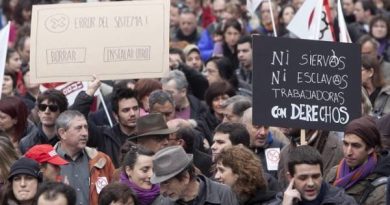
Passengers and railway workers are in danger. The central and regional governments are not up to the task. We support the mobilizations and railway strikes called. For safety and better working conditions, the system must be controlled by workers and users.
By Gérard Florenson
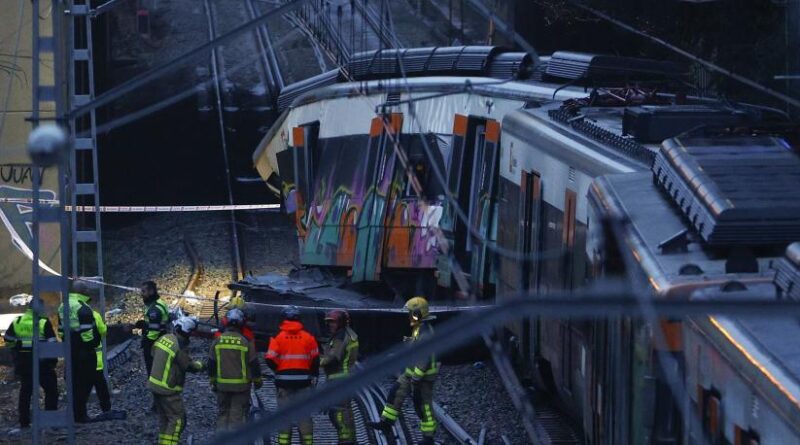
A railway accident has caused more than 40 dead and a large number of injured. An investigation is underway, but what is already certain is that the disaster was due to inadequate maintenance of the equipment, in particular the roads. The functioning of capitalism is the antithesis of “precautionary principle”. Operating companies skimped on safety, hence the insufficient frequency of inspections, until the day…
Not only was this tragedy not due to bad luck, but in the following days, other lines, especially in Catalonia, where a machinist died, suffered accidents of varying severity. Although the weather conditions were harsh, They were predictable, and the risks could have been foreseen instead of continuing to operate the trains as if nothing had happened. The priority for decision makers is that workers come to work, even if it means risking their lives.
The resulting chaos, especially in Catalonia, where railway workers went on strike and authorities were forced to suspend railway service, has generated debate and controversy. Before getting into the matter, We want to clearly express our support for the railway workers and their unions, who did everything possible by refusing to endanger the lives of passengers and train drivers, and by requiring inspection and repair of equipment and roads.
The employers and their henchmen are outraged by the blockades and denounce the railway workers for keeping passengers hostage... But the strike is not the main cause of this situation; are the daily delays, the train cancellations and the poor travel conditions we suffer. And this is what travelers, together with the railwaymen, they must put an end to demanding “decent trains”, as many associations say.
A hate campaign against railway workers
This outbreak is not exclusive to the current situation or to the Spanish State. The mobilizations of public employees always provoke the anger of the right and the lackeys of capital. Their salaries and acquired rights are denounced by people who earn much more and who, mostly, They mainly employ others…
But in Catalonia, This campaign is taking a particular turn. Railway workers are not only the subject of the usual slander, but some Catalan pseudo-nationalists accuse them of being agents of the Spanish State...
This could be funny. Some journalists argue that RENFE was a creation of Franco (which is true, but in France its equivalent, the SNCF, It was a creation of the Popular Front) and they reveal a certain nostalgia for the time when private companies managed the lines... Are you in favor of more privatizations? One would assume so.
Others, or sometimes the same, They point out that the Francoists fired tens of thousands of Catalan railway workers to replace them with Spanish ones and that the current railway workers are, somehow, heirs of fascism and their hatred of Catalonia.
This is really scary. Tens of thousands of railway workers, but also teachers, postmen and hospital staff, They were kicked out of their jobs by fascists, and not only in Catalonia. Throughout Spain, The working class was harshly repressed by the victors: executions, imprisonments, forced labor and dismissals.
The railway workers on strike do not long for Franco's regime. Their unions fought under the dictatorship; leaders and activists were imprisoned without the regime caring if they were Catalan or from another region of the peninsula1. Regardless of what we think of its shortcomings, We respect and praise your commitment.
In the meantime, most of the Catalan upper class did business with the regime. In Barcelona, They amassed fortunes thanks to the great public works projects initiated by Mayor Porcioles, whose political career is revealing: former member of the Catalan League, the right-wing Catalan nationalist party2, who joined the Franco regime and was a member of Opus Dei. All these people, Of course, They found new positions during the Transition.
The transfer of Rodalies, a miraculous solution?
The transfer of Rodalies is one of the central demands of the Catalan nationalist parties, who use it as leverage against the government, who cannot do without your support. The objective is to gradually recover the prerogatives of a State. In fact, It is a manifestation of its transition towards a simple and reinforced autonomy within the framework of the Spanish State.
But the management of Rodalies by the Generalitat cannot, alone, change a catastrophic situation caused by decades of neglect and lack of investment. To reverse this trend and prioritize rail transport, it is necessary to allocate the necessary resources to ensure the security and efficiency of the Rodalies network, which requires active supervision by railway workers and users. Neither ERC nor Junts have said much about their specific action plan: Give us the power and we'll see what happens. What can we expect more from political leaders who are avowed defenders of economic liberalism? The merit of the “railway crisis” is to have exposed these people. Let us hope that this definitively destroys the myth of Catalan unity without class distinctions...
All railway unions oppose the transfer. Not because of anti-Catalanism, as some accuse them, but for prudence. How could they trust a Generalitat as anti-worker as the successive Spanish governments?? further, have seen what happened in neighboring countries with the decentralization of regional line management: initially, public money is injected to improve the situation; then, under the pretext of opening to competition, privatization occurs, employees lose their status and pay scales deteriorate. Thus, The railroad workers believe that they will be able to defend themselves better against a large company than against several small ones., which is understandable. To have decent trains in Catalonia, we must reject all privatization, any opening to competition, and defend and improve the situation of railway workers. This requires confronting both the Catalan and Castilian capitalists..
The Rodalies project is like the fight for a Catalan Republic. To convince people, We must propose a policy that completely breaks with the capitalist system and its local agents, a policy that benefits everyone who lives in Catalonia, without exploiting anyone, regardless of origin. Only a government of the workers and the people could carry out such a task..
On this way, We must support the railway workers' strike called for the days 9, 10 Y 11 and the mobilization of 7 February in Catalonia.
1.- For example, Marcelino Camacho, castellano, metallurgical, son of a railroad worker and founder of CCOO (Railway Workers Union of Catalonia), He was sentenced to 9 years of prison in 1967. After Franco's death, shared the pernicious policies of the PCE (Spanish Communist Party), of which he was a member. Nevertheless, We do not equate it with the Catalan bourgeoisie that collaborated with the dictatorship!
2.- Your leader, Francesc Cambo, welcomed the fascist coup in the name of order... Many leaders of the League abandoned their Catalan nationalist convictions to join the new regime.