Railway accidents: catastrophes that are not natural at all
The repeated and serious accidents in which people die put en question to the government and the capitalist system for which life is worth less and less.
By Gérard Florenson
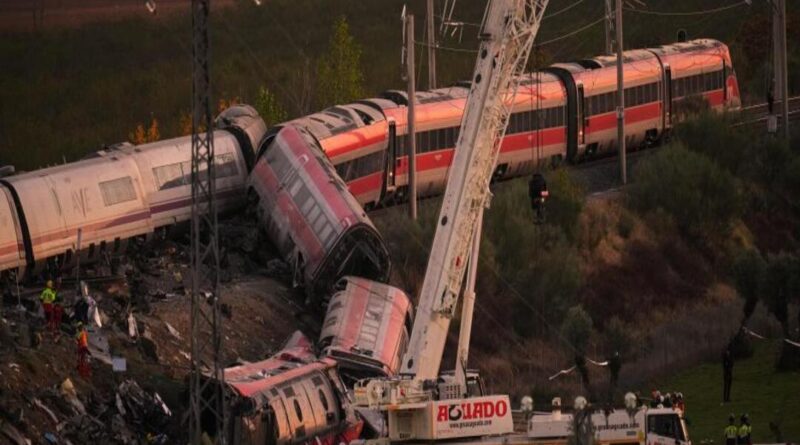
The collision of two high-speed trains near Toledo has caused dozens of deaths and a large number of injuries. This tragic collision between two AVE has revealed the serious deficiencies of the Spanish railway service, despite the fact that high-speed lines are reputed to be safer. The comparison with other European countries is illuminating: The high-speed network of the Spanish State has more kilometers of tracks, but the human and material resources allocated to maintenance and security are considerably lower.
It is not that capitalists are more virtuous in France, Germany or England. Everywhere, the priority given to high speed, for reasons of both prestige and economic profitability, has been imposed to the detriment of the secondary network and freight transport, for the benefit of road transport, most lucrative. This has caused the closure of stations and lines, transferring reliability and safety problems and harming commuter train users: material obsoleto, delays and cancellations. Incidents and accidents are numerous, although less spectacular…
But, while other governments have assumed their priorities and developed high speed to favor business travel and tourism, The successive governments at the head of the Spanish State have allowed all networks to deteriorate, as we have seen with Rodalies.
Criminal negligence
The Adamuz accident was caused by the breakage of a damaged section of track, something that could have been avoided through more rigorous inspections. The one in Toledo is due to signaling problems. To avoid responsibility, Oscar Puente, Minister of Transport, has pointed out a human error and has denounced, even before any investigation was started, to a control agent who supposedly gave the green light to the AVE driver to resume traveling at full speed, when another train was stopped on the same track.
The minister's statements have caused, logically, the indignant reaction of the railway unions, who have joined the numerous voices demanding his resignation. But, even if there had been a wrong order, what is in question are precisely the safety devices. How is it possible that the presence of the second train was not detected?? How can the march be resumed in these conditions without safety devices blocking circulation??
The first answer is that the control system installed on the Madrid-Seville line did not allow it and that its replacement with a more advanced system had been postponed for budgetary reasons..
The dance of the hypocrites
The enormous scandal unleashed by the Toledo catastrophe has not been limited to the legitimate search for its causes and the necessary measures to prevent it from happening again at all costs.. There is talk of warnings from experts and railway unions, but only to fuel the controversies given the proximity of the general elections.
Alberto Núñez Feijóo multiplies the complaints and invectives. It relies on popular indignation to make people forget, at least temporarily, the crisis and social mobilizations in defense of the right to housing, a central issue to which his party, at the service of vulture funds and owners, is of course unable to offer an answer. By placing himself on the front line against Sánchez, exhibits a combativeness that it needs to defend the PP against the competition of VOX.
The newspaper Público has pointed out the contradiction between Feijóo's current speech and the one he maintained in July 2013, when a train derailed in Angrois and caused 80 deaths. Then there was talk of "human error!", No commission of inquiry was proposed, much less resignations were demanded.! It is true that Feijóo was then president of the Xunta de Galicia and that Rajoy, also from the PP, presided over the Government.
But, although the deterioration of rail service did not begin during his mandates, Sánchez does not stop having a great responsibility. As with the crucial question of housing, His Government has not broken with the policies of his right-wing predecessors. It has continued to apply liberal policies that have harmed public transportation in the name of free competition.… and business benefits.
mobilizations and general strike so that the crisis is paid by those who generated it, which hoped to recover thanks to popular mobilizations for the right to housing, is disoriented and divided. A part of his base joins his partners in the government coalition and the unions in demanding Puente's resignation or dismissal..
The deadly logic of capital
In the long history of the railway, This has always been a source of profits for capitalist investors.. Even when the State seems to be in control, Infrastructure and rolling stock constitute a very profitable market. The community assumes a large part of the costs, The contracts are public and the benefits are private. Y, Of course, it is more profitable to build new high-speed lines, with increasingly sophisticated trains, to pay workers to inspect the roads.
The separation between ADIF, responsible for infrastructure, and RENFE, as has happened in other countries, has gone in the direction of socializing costs and privatizing benefits. The opening of high-speed lines to competition has hardly benefited users. The price war has not reduced the profits of operators: Savings have been achieved by putting pressure on workers' wages and working conditions… and also security, since budget restrictions have affected this item.
The situation requires urgent measures that neither the Government nor the right can commit to adopting., because they imply breaking with the liberal policies that everyone shares:
- Cancellation of the separation between ADIF and RENFE, through the creation of a unified public entity 100 %, managed under the control of workers and users.
- End of opening to competition.
- End of priority given to high speed and exclusively road transport, with investments in secondary lines and rail freight transport.
- Massive investment in the safety of facilities and circulation, with the hiring and training of workers in a proportion consistent with the needs.
But satisfying these demands, elementary for those who really want to defend public transport at the service of the population, It is incompatible with the domination of capitalists, for whom its benefits are worth more than our lives.
Of course, our mobilizations can achieve partial progress. But, as long as we fail to question its power, the capitalists, backed by governments at your service, They will strive to preserve the essentials of their profits.
That's why we must tear down their entire system, end capitalism and establish a socialist society.
You may also interest you: “Crisis ferroviaria I: Our Lives first”, Railway crisis II: Let's support the claims of workers and users, https://soles.org.es/2026/02/04/crisis-ferroviaria-iii-como-escapar-de-la-debacle-ferroviaria-en-catalunya/