US-Iran Crisis: Out Yankees Middle East!
He 3 from January, un dron de EE.UU. was an attack near Baghdad airport. The ten deaths it caused include Iranian General Qasem Soleimani, number two of said regime, and Abu Mahdi al Mohandes, top leader of Iraq's pro-Iran Shiite militias. The Yankee attack, which provoked an Iranian response in missiles, put the region on the brink of war and shakes the world situation.
In a climate of great tension, several events have unfolded since the attack. Oil rose 4.5%, stocks fell, EE.UU. announced the reinforcement of 3.500 military personnel, there were mobilizations of hundreds of thousands in Iran and Iraq, The Iraqi parliament requested the withdrawal of all foreign troops from its territory and Iran produced a first response by launching several missiles that hit two North American military bases in Iraq., among other consequences. Beyond our total opposition to the Iranian regime of the mullahs (Islamic clerics), theocratic and repressive, and the government of Iraq, The Yankee military operation is a new attack against the sovereignty of both peoples. We repudiate this imperialist aggression, that puts the old slogan “Yankees, go home”.
The course of the crisis
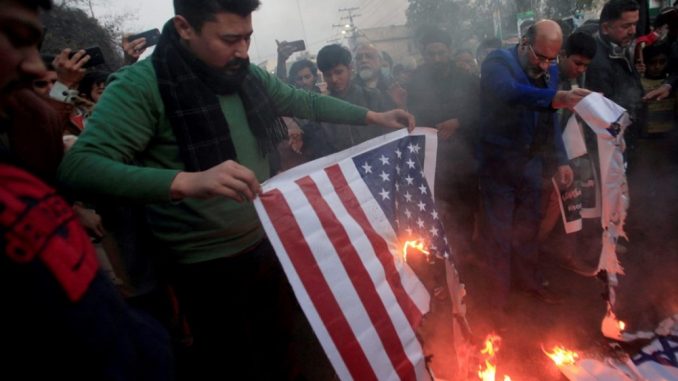
The crisis generated by the assassination of Soleimani has not been closed. A Baghdad, Saturday 4, Tens of thousands mobilized at the funerals of those murdered shouting “Death to the United States” and “No.”, no Israel”. Many members of military units paraded, who consider Soleimani and Mohandes heroes. Senior Iraqi officials were also present: Prime Minister Adel Abdul Mahdi and pro-Iranian commander Hadi al Amiri.
On Sunday 5 there was another march, this time with hundreds of thousands, in the city of Mashhad, accompanying the coffins of Soleimani and the other fallen Iranians. Monday 6 another hundreds of thousands, millions according to some, They marched in Tehran. It was the largest mobilization since the funeral of the leader of the revolution of 1979, Ayatollah Ruhollah Khomeini. In the presence of Iran's top leader, The ayatollah Ali Jamenei, chants against the US. and Israel demanded a forceful response to the murder.
The Iranian government threatened to avenge the crime. “We will avenge his blood together”, declared President Hasan Rohani, and “wherever they can be reached”, added Gholamali Abuhamzed, high commander of the Revolutionary Guards. According to Soleimani's successor, el brigadier Esmail Ghaani, and the leader of Hezbollah[1], Hasan Nasrallah, The objective is to remove the Yankee troops from the region. When addressing the crowd in Tehran that said goodbye to the remains of his father, Soleimani's daughter, Zeinab, threatened to attack the American army.
While Trump threatened to bomb 52 Iran points, a good part of world leaders try to put cold cloths. European leaders asked Iran not to respond militarily and to remain “within the nuclear agreement” (agreement that Iran denounced although it has not completely broken with UN controls). Until the monarchy of Saudi Arabia, Yankee ally and archenemy of Iran, fearful of possible attacks on its distilleries, has called not to lose calm.
Iranian “revenge” was “a slap in the face”: he 8 January launched 22 ballistic missiles that hit two US military bases in Iraq from where the drone attack would have been launched. According to the US, there were no deaths. It was later learned that Iran notified the Iraqi government before the attack so that it could empty the area and avoid fatalities.. CNN immediately came out to claim the “moderate” nature of the Iranian response and the search for a climate to “de-escalate” the conflict.. Even so, if it is confirmed that an Iranian anti-aircraft missile mistakenly shot down a Ukrainian plane departing from Tehran, causing 176 dead, Trump will seek to use that tragedy to his advantage.
Finally, Trump announced new economic sanctions, He said that he will continue studying “a response” to the Iranian attack and called on the European Union (EU) and NATO to break the old nuclear agreement and renegotiate a more demanding one and become more involved in the Middle East. few hours before, Iraqi Prime Minister Abdel Mehdi stated that he had invited Soleimani to negotiate with Iran to lower tensions in the area, at the request of the American president: “Trump asked me to mediate with Iran, and murdered my guest.”[2].
The perspectives of the conflict
Some international analysts consider it possible that this crisis will lead to an open military conflict between the United States.. and Iran. Others handle less serious hypotheses. It is that beyond the negotiating will of both parties (The Iranian foreign minister stated that with the 22 missiles launched, the “revenge” is now complete), The magnitude of the attack has increased tensions in the region and opened a new situation. The crisis can unleash a process of action and reaction that goes beyond the initial will of the leaders of both parties.
The Iranian leadership threatened to bomb Dubai, Haifa (Israel) and United Arab Emirates, among other things, If the Yankees militarily replicate the launch of the missiles. And it is difficult to anticipate the future of the conflict. But the crisis can change the course of the situation in the entire Middle East. For example, The EU has been asking Iraq not to move forward with its plan to withdraw foreign troops from its territory, since this, among other consequences, could allow some recomposition of the weakened ISIS or increase political polarization in Israel, where the worn-out Netanyahu threatens new attacks on the Palestinians to try to rebuild himself.
The Yankee failure in Iraq and the Middle East
EE.UU. It cannot overcome the stagnation of its actions in Afghanistan and Iraq and has been greatly weakened in a region in which it led an invasion of the first country and two “Gulf wars” against the second., where he ended up dethroning his former ally Saddam Hussein. In Afghanistan, almost 20 years after the invasion against the Taliban, These have recomposed and control part of the territory. This forced the Yankees to negotiate with the same people they held responsible for the attack on the Twin Towers..
An Iraq, your situation is as or more complicated. According to specialist Emma Sky[3], in 2009 the US. They were very strengthened in Iraq, having played a key role in the defeat of Al Qaeda in the civil war that followed the invasion and fall of Saddam's regime in 2003. In Baghdad they had their largest embassy in the world., more than 17 hectares and 12.000 employees. But his policy of supporting the Al Malaki government failed. Al Malaki persecuted the important Sunni minority on which Saddam relied (almost a 40% population), which, combined with the withdrawal of a portion of the North American troops, allowed ISIS to grow as “protector of the Sunni nation.”. In 2014 ISIS controlled a third of Iraq, which led Obama to withdraw support for Al Malaki, send troops again and accept a broad coalition against ISIS. Among other forces, “Kataib Hezbollah” participated in it (KH), an Iranian-backed Shiite militia that was officially incorporated into the Iraqi security forces through an umbrella group known as the Popular Mobilization Forces.”[4].
As part of these agreements with the Iranian regime and its allies, in 2015 Obama finalized the nuclear deal: representatives of Yankee and European imperialism, Russia and China, They signed a shameful treaty with Iran to stop the latter country's sovereign nuclear development. The war against ISIS is over, The Iraqi Hezbollah militias began to harass the Yankee troops. What was known as an “unnatural” coalition had broken up and tensions were increasing..
Iraq, Iran and Lebanon: the villages, against their governments
The Yankee attack came to change, for the moment, the axis of the popular struggles that were being waged in these countries against repudiated political regimes. An Iraq, since October 2019, Young, most unemployed or underemployed, They led an uprising that became widespread against the tight-lipped and corrupt government of Prime Minister Adel Abdel Mehdi.. Using Iraqi repressive forces and pro-Iran militias, repressed protests with violence: there were some 500 dead protesters and 21.000 wounded. The rebellion forced Mehdi to resign, although it is still in operation waiting for a replacement. For two months, thousands demonstrated in Baghdad's Tahrir Square and then ended in harsh clashes with repressive forces..
The movement spread to other cities. These mobilizations against poverty, the austerity policies and corruption resulting from the country's ruin due to the American occupation, in 2019 They also faced Iran's influence over the local government and the activity of its affiliated militias., so the protests attacked Iranian diplomatic headquarters in Iraq[5]. The pro-Iran factions, for its agreement with the US. to support the Iraqi government, They called for trust that the Yankee occupation favored the country.
In Iran, the mobilizations of December 2019 against the increase in fuel prices were also massive. Like in Iraq, were violently repressed by the mullahs' regime, leaving a balance of more than 300 dead. The protests were a continuation of those of 2017-2018 against poverty and social inequality, now aggravated by the Yankee economic blockade, but more massive and radicalized. This shows a growing weakening of the regime.
In Lebanon, The protest broke out at the end of last October following the attempt to impose a tax on the use of WhatsApp. This broke the patience of the hungry people., fed up with adjusting and corrupt governments. There, too, the youth were the vanguard of large protests, that lasted for months and ended up forcing the resignation of Prime Minister Saad Hariri. Again the “everyone leave”, against the entire political regime, was a common denominator of the protesters. This repudiation includes the pro-Iranian Hezbollah, that although yesterday it was part of the heroic resistance to the Israeli invasion, it is now part of the Lebanese government and as such played a repressive role towards the mobilizations. The imperialist attack occurred in this convulsive framework, in which the people of the Middle East were fighting tough battles against their governments and reactionary regimes in a new wave of the Arab Spring that began a decade ago.
The background of this imperialist aggression
Trump changed Obama's line towards Iran. He broke the nuclear agreement and imposed strong pressures, such as the harsh economic blockade to force him to make greater concessions, with more rigorous inspections of its nuclear facilities, limit its missile development and cease aid to regimes and movements related to Iran in the region: the syrian government, Shia militias in Iraq, Lebanese Hezbollah, Houthi rebels in Yemen, among others.
Given the Iranian government's refusal to accept these pressures, imperial aggression did not stop escalating and causing clashes: the brutal economic blockade, which causes an economic crisis of magnitude in Iran; sending Yankee warships to the Strait of Hormuz, off the Iranian coast, where he passes 20% of global oil traffic; the shooting down of an American drone by the Iranian militia; attacks on oil tankers in the strait; the hijacking of an Iranian oil tanker by Britain and the detention of a British tanker by the Iranians in response; the attack of the Yemeni Houthis, supported by Iran, to the main distillery in Saudi Arabia; the repeated bombings by Israeli aircraft on Iranian targets in Syria. These are some of the events that occurred in these months of growing tension.
Because, the drone attack, which surprised the Iranian leadership and strategist Soleimani himself, It is not lightning in the open sky or just the product of tactical brutality: It is Trump's choice of harsh aggression among several options considered by North American military intelligence.. He 27 from December, the rocket attack by Shiite militias on a US base in Iraq, which left several soldiers and a mercenary dead, was responded to by Yankee bombings in Iraqi and Syrian territory at the bases of the pro-Iranian militias to whom they blamed the attack.. The balance of that US action was much higher: 25 killed and over 50 wounded. The indignation of the Shiite militiamen grew and in order to 2019 hundreds of them, surpassing the custody of the Iraqi army that let them pass, They marched before the US embassy. a Baghdad, they stoned her, They occupied its periphery and burned part of its facilities. The Yankee soldiers stopped them with gas and rubber bullets when the protesters had reached the hall. In moments of great tension, there were fears for the lives of diplomatic personnel. A) Yes, like ghosts from an unsurpassed past, images of the taking of the Yankee embassy with hostages in 1979 in Tehran (Iran) and the assault on the Yankee embassy in Benghazi, Libya, in 2012, where the ambassador was shot[6]. Trump's response, the assassination of Soleimani, Iran's top military man, commander of the elite Al Quds force of the Revolutionary Guard and considered the architect of the entire Iranian military deployment in the region, take the confrontation to a higher scale.
For the sovereignty and self-determination of Iraq and Iran, without any support to their governments
Trump, the head of the cruelest imperial apparatus on the planet, justified the death of Soleimani by saying that he was “a terrorist”, responsible for murders of Americans in the Middle East, that he was preparing an attack against Yankee personnel and that his “preventive” assassination prevented a war. Soleimani, by the way, he was not a revolutionary leader (how the uncritical defenders of the Iranian government try to make it up) not a “martyr” in life (how the mullahs' regime embellished it), but the military leader of a government that a few weeks ago massacred his fellow citizens who came out to protest against the adjustment. The militias that this general influenced in Iraq, directed by Mohandes, they also repressed, as we pointed out before, the recent Iraqi popular uprising.
further, Iranian troops in Syria and the militias of their ally Hezbollah are co-responsible for hundreds of thousands of deaths with which the genocidal Al Assad managed to stay in power and defeat the “Syrian Spring”.
Nevertheless, Revolutionary socialists are not confused. The attack that killed Soleimani, Mohandes and his companions are an attack on the sovereignty of the people of Iraq and Iran and only they have the right to judge them. It is part of an escalation to break the Iranian regime's refusal to accept imperial pressures.. And in that fight we are not neutral: we are together with the people of both attacked nations, demanding justice, in the fight for the total withdrawal of imperialism from the Middle East, at the same time that we demand from the governments of the area a true anti-imperialist “war”. Beyond this or that armed action, The axis of this “war” is the push for consistent mobilization against the Yankee interests and their allies throughout the region to put all resources at the disposal and under the control of the people..
These are the main “missiles” that the Iranian government and its Iraqi counterpart are not willing to fire. That's why yesterday they agreed with Obama, Then they sought an agreement with imperialism and European corporations to counter Trump's blockade instead of relying on the anti-imperialist mobilization of the entire region., and today they prefer to adjust and repress their people than touch the interests of local capitalism. Without ruling out that the current crisis forces them, despite himself, to advance in anti-Yankee actions that are harsher than those planned, Due to their capitalist class character, both governments oppose the development of a consistent anti-imperialist mobilization that questions the economic and political bases of the capitalist-imperialist system in the region..
The causes of the crisis and its prospects
There are different opinions about what happened and its possible dynamics. About the causes, Some analysts emphasize the proximity of the electoral campaign in the US. and Trump's need to use this aggression and the campaign against Iran to win votes. Others emphasize the growing dynamics of the confrontations and the brutality of Trump's responses. Although these and other elements of the situation must be taken into account, The center of what happened must be sought in the deep crisis that the capitalist-imperialist system is going through since 2008 and the loss of the traditional hegemonic role of the United States. and its failure in the Middle East, rich in oil. The revolutionary situation that the region is experiencing, whose workers and people are obtaining partial victories, exacerbates the crises and disputes between the different bourgeois sectors over the distribution of surplus value. in that fight, imperialist powers seek to maintain and improve their areas of domination and exploitation. This background is what is giving rise to the “crises.”, wars and revolutions.
The old Arab “nationalist” regimes of the 20th century gradually lost their “national” characteristics to weave different agreements with multinationals and imperial powers.. As managers of local capitalism, They faced the mobilizations and demands of their workers, young people and people as the economic crisis wreaked havoc. This confrontation against increasingly rich ruling and business elites constitutes the revolutionary process called the Arab Spring..
For that same reason, although some of these regimes have had or have strong friction with the State of Israel, that “land aircraft carrier” and enclave of imperialism, they are incapable, despite his speeches, to unite the anti-imperialist mobilization of all Arab peoples to defeat it and liberate the Palestinian people and other peoples of the region. The new wave of rebellions and revolutions that crosses the world has one of its epicenters in the Middle East. New generations of workers, young boys, women, They take to the streets to question the political regimes that manage the crisis, many of whom are mired in corruption scandals, demanding social and democratic responses that these governments are incapable of granting. And those struggles achieve important triumphs, that weaken the rulers.
Imperialism and the other powers, who redouble their dispute to obtain new and greater quotas for super-exploitation of the people and their common goods, They try to take advantage of the outbreak of these political crises of the old local capitalist regimes and intervene seeking to turn them in their favor.. This is what happened in the Syrian civil war., where the opposition to the dictator Al Assad, in the absence of a revolutionary alternative capable of developing popular mobilization and its incipient forms of self-organization, was taken over by Islamist currents supported by different regional powers, like Saudi Arabia, Qatar and Türkiye, or by interventions of imperialist nations, giving rise to aberrations like ISIS. Together with Al Assad, Iran and Russia played their counterrevolutionary role in the dispute and burial of the revolution.
In the world situation, Iraq appears as the most likely territory in the Middle East where the confrontation between the revolution and the counterrevolution is going to heat up.. The pro-Iranian governments, starting with Iraq, They will try to divert the just anger against their disasters behind an anti-American discourse of supposed defense of national sovereignty. They are going to try by all means not to be overwhelmed by the anti-imperialist mobilization that for now considers them as its leadership for that fight.. It will depend on the course and depth of this mobilization whether these directions can use this relative strengthening to stop the social process that had been questioning them or that, Conversely, be overwhelmed and questioned by the masses in struggle.
With the excuse of a supposed “anti-imperialist unity”, From Castro-Madurism to Kirchnerist sectors, they seek to beautify those regimes repudiated by their people.. Against this opportunist “campism”, Revolutionaries must combat imperialist aggression by promoting the broadest unity of action but without placing an ounce of trust in those regimes and leaderships.. The revolutionary mobilization of the Iraqi and Iranian people must combine the fight in defense of national sovereignty against imperialist aggression, overcoming the limitations and obstacles of those directions, with the demand for democratic freedoms for the people mobilized to promote their independent organization and demand a program of anti-capitalist measures that allow us to respond to pressing social needs, in the strategy of a Federation of Socialist Republics of the Middle East.
On this way, We invite organizations and activists who consider themselves revolutionaries to actively join the construction of this socialist and internationalist tool that is the LIS.
[1] Shiite Islamist political party and militia of Lebanese origin, Iran's ally. After the civil war in Lebanon he joined the government, as part of agreements with its Sunni rivals. It has played an important role in the Syrian civil war supporting the dictator Al Assad, It confronted ISIS militarily and has a presence in several Middle Eastern countries.
[2] The actions of the United States in relation to the assassination of General. Qasem Suleimani, por News Front/Sharmini Tharmaratnam, 7/1/20 (https://www.aporrea.org/internacionales/n350702.html)
[3] Researcher at Yale University. Author of several works on the Middle East, served in Iraq in 2003-2004 as Kirkuk Governorate Coordinator, and in 2007-2010 as political advisor to General Raymond Odierno, then commanding general of US forces in Iraq.
[4] The death of the American-Iraqi relationship, Foreing Affairs, 3/1/20 (https://www.foreignaffairs.com/articles/iran/2020-01-03/death-us-iraqi-relationship).
[5] Iraq: The exhausted Iraqi working class seeks a way out, firing several shots while trying to get other regiments to join. The. Lion, 6/10/19 (https://lis-isl.org/2019/10/06/irak-savas-yorgunu-irakli-emekciler-cikis-ariyor/).
[6] US-Iran rivalry poisons Iraqi rebellion, in Emre Güntekin, 1º/1/20 (http://lis-isl.org/2020/01/01/abd-iran-rekabeti-emekci-isyanini-zehirliyor-emre-guntekin/)