
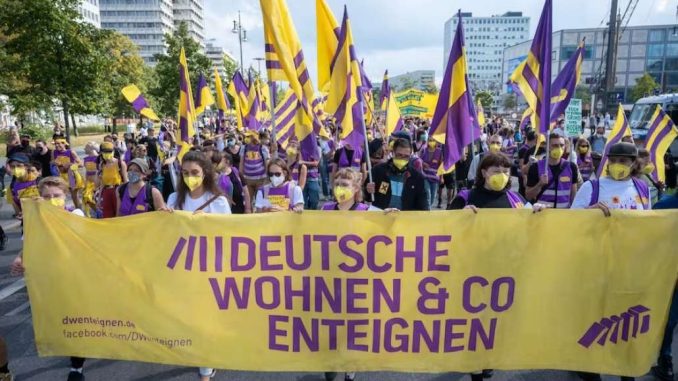
Berlin, Germany. roof for everyone!
The German capital demands the implementation of the referendum on the expropriation of housing. The commission of experts presented the final report that confirms the legal viability of the socialization of land after the victory of the popular plebiscite in favor of the expropriation of large real estate groups.
ByCarolina Menendez Trucco
After knowing the final report, the commission of experts, which was created as a result of the successful referendum on land socialization in Berlin, no ve obstáculos para la expropiación de grandes empresas inmobiliarias. Around the 60% voted in favor in autumn 2021. Along with the general elections, in September of that year, More than a million Berliners leaned in favor of the expropriation of real estate companies to regulate the market, and thus be able to lower the exorbitant price of rents. This clear majority voted in favor of the state incorporation of more than 230.000 departments, reached the measure to companies that have in their possession more than 3.000 properties.
In sum, The popular consultation was first successfully carried out during the last German parliamentary elections, Then a commission of experts was created in the Senate that debated for a year about its optimal implementation.. And as a result of this, The latest documentation presented was reached, which constitutes a framework for the future transfer law and compliance with the referendum.. In other words, Berlin chose a roof for everyone. And now it's the turn of politics.
Towards the common good
The report of the expert commission provides the necessary substance to promptly present a legal framework on this basis. After the favorable result obtained in the plebiscite (59,1%), and for the commission to say that it is feasible, de facto expropriation still requires certain jurisprudence in its execution. And for the referendum to be implemented, The initiative had to pass through the Senate[1], since to move forward with the transfer of real estate to common property there must be a law that establishes the economic compensation of expropriated companies.
The Berlin Senate, or rather the current government coalition of social democrats (SPD) and conservatives (CDU/CSU), are called to introduce all the measures that are necessary to draft the rules that protect this purpose. The initiators of the referendum, the popular expropriation initiative “Deutsche Wohnen & Co Enteignen” (Dwenteignen)[2], as well as The Left (The left) and recently the environmentalist green party (Alliance 90/The Greens), They want a quick start-up.
Who owns the city?
Indeed, Berlin has become the capital of renters: four out of five Berliners rent. further, The concentration is such that the 81,5% of the entire market is managed by a few large companies. Of the 1,9 millions of properties throughout the city, 1,5 millions are rental homes that they themselves rent. Y como si fuera poco, in April 2021, Germany's Federal Constitutional Court overturned decision to impose a rent cap in the city, that is to say, the maximum limits imposed by the State for income. Another bad prognosis was added to the unfortunate event.: the projection for the 2030 of at least 200.000 new properties needed to address the housing problem.
After all, The real estate crisis has worsened in recent years.. Berlin went from being one of the cheapest cities to live in, to one of the most expensive, mainly thanks to the rapid and exponential monopolistic concentration and the consequent financial speculation in the sector. Hence, the Berlin Senate pursues the objective of expanding the public housing stock through new constructions and purchases., to curb the increase in rents in the city through its state-owned associations such as Degewo, Howoge, Berlinovo, city and country, among other.
The mathematics of socialization
How much would it ultimately cost to convert the housing stock of large for-profit companies into common property?? A question that is not so easy to answer. What to consider when determining the amount of compensation, that is, when it comes to compensating expropriations, is what a property is really worth outside of speculative price spirals. There are several methods to determine this market value. Following the fair rental model proposed by the Berlin citizen initiative “Deutsche Wohnen & Co expropriate”, large housing groups would receive compensation accordingly, which could be in refundable bonds 40 years, but taking into account the interests of tenants and not just those of corporations. This roadmap foresees that, when socializing the apartments, rent increases can be stopped and affordable amounts can be ensured in the long term. According to the Senate's forecasts, compensation costs could amount to between 29.000 Y 36.000 millions of euros, while the DWenteignen expropriation initiative, instead, wait between 7.300 Y 13.700 millions.
In that same line, A study recently published by the Rosa Luxemburg Foundation analyzes the groups of owners in the real estate market by comparing the incomes of listed companies with those of state companies. An appropriate reference for calculating compensation can be seen therein.: How high a non-speculative income must be to be economically viable. In any case, This project should be framed in a new law.
After the final report of the commission of experts was known, “German living & Co enteignen” called for the current Berlin black-red coalition, composed of conservatives (CDU/CSU) and social democrats (SPD), to quickly present a legal framework. According to this, The State of Berlin has legislative competence and would act correctly if it moved forward with the implementation. Experts are also convinced that fair compensation is possible. Like that and everything, not everything is rosy.
For and against expropriations
As it was not difficult to wait, both the extreme right party (AfD) like liberals (FDP) They are against it from minute zero. Meanwhile, Housing rights advocates urge ruling coalition in capital to fulfill referendum mandate 2021 and introduce legislation to socialize the properties of corporate real estate agents to solve the housing crisis. Although the Greens (Alliance 90/The Greens) have not been able to agree on a common position for a long time, have given contradictory signals and even considered that such a step would only be possible as a last resort, apparently they are now tentatively supporting the campaign. Instead, The left (The left) defended the referendum from the beginning and, Thus, just as the militancy of the tenant movement took a confrontational course for affordable rent instead of big profits.
Collective property regime
The commission, composed of 13 experts, spent more than a year addressing legal issues related to change for the common good. Such a report can now serve as a model for a secure partnership law. Well according to the article 15 of the Basic Law of the Federal Republic of Germany to carry out the transfer of residential real estate to common ownership a legal framework is required (Socialization Act), that also establishes the manner and amount of compensation.
In German there are two terms to differentiate the types of transfer: while theexpropriation proper (the expropriation) addresses individual assets, thesocialization (the socialization) aims to transfer entire companies and economic sectors to the common economy. According to the Federal Agency for Civic Education, It is an economic form whose most important purpose is to cover social needs and is not oriented towards private profit.. The meaning of the state appropriation of apartments then is to avoid excessive rents. Thus, The course of this is to remove living space from the free market, thus leaving socialization as a priority.
A roof for everyone!
The public debate on the expropriation of large real estate companies in the face of the exorbitant increase in home rental and purchase prices, without a doubt, assumes that the mere prospect of success of this change represents a challenge. Not only in Berlin, also in the rest of Germany and the world. But beyond the difficulties and the new legal framework required for its implementation, the first step has already been taken. It is a triumph of popular mobilization, who gathered signatures for the referendum, he imposed it, then he won it with a strong campaign, marches and other pressure initiatives, and now it continues to complete the expropriation.
Many rely on public housing to create more living space. further, It is about passing homes that belonged to large real estate companies into the hands of the State., not from individuals. Expropriation cannot be reduced only to the legal act of a change of ownership.. The main objective should be to put important areas of society under democratic sovereignty.
[1] The Senate is the Executive Branch of Berlin, made up of the mayor and eight senators. The German upper house is called the Federal Council.
[2] “Expropriate Deutsche Wohnen and Co.” It is the popular initiative of expropriation, the initiators of the referendum. Unlike DW, one of the largest real estate companies.