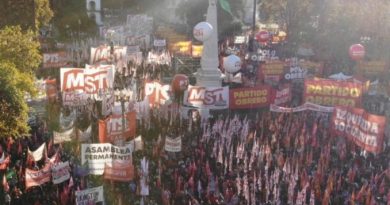
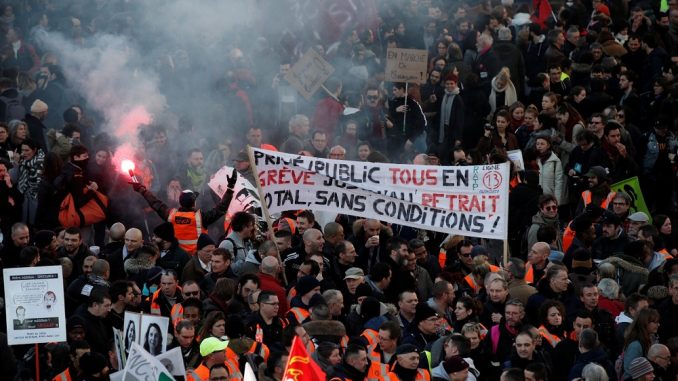
France: Macron draft pension reform in 10 Questions, Answers
The history of our pension system PAYG, the scrapping of, the successive "reforms" and the discourses that accompany them is essential to understand Macron's project, the latest avatar in an unbroken series of attacks since 1991 by governments of the right and "left". The Commune offers its dossier in 10 questions and answers.
1. What is the current pay-as-you-go retirement system like??
It is part of the Social Security system established in 1945, result of the conquest of the workers in the wave of insurrectionary strikes in the immediate postwar period. It is based on two principles:
Not immediately receive a part of the salary. We talk about deferred wages: net salary is paid to the employee at the end of each month, once the part of the deferred salary (contributions) paid to Social Security. The sum, net salary and deferred salary, form the gross salary. This gross salary belongs to the workers: exempt the employer from his contribution to social security, transforming it into tax, it is robbing the worker!
Put that deferred salary in a common fund to ensure each other at every moment of life (disease, unemployment, retirement, family) according to the principle of worker solidarity: each unite contributes for all and all for each unite. Each one contributes according to their salary and receives according to their needs: Thus, health or retirement benefits do not correspond to the individual contribution of each unit (unlike pension funds or retirement by points).
2. Before 1945, how did it work?
Before 1945, those who could afford it reserved money in private financial organizations: Thus, It was a system based mainly on capitalization. Only those who worked in certain sectors had specific pension plans since the 19th century (1858 for gas workers of the Parisian Company; 1860 for railwaymen of certain companies; 1890 for all railwaymen; 1894 for miners). It was the social struggles and the relationship of forces that imposed its establishment to respond to poverty wages and the great difficulties. Mostly, after the economic crisis of the 1930s, Retirees live in misery and destitution if they can no longer work or be housed and fed by their families.
3. What were the previous attacks on the current pay-as-you-go pension system??
Under the pretext of preserving the distribution regime, ensure its sustainability and financial viability, the State allied to the bosses carried out scrapping operations. Since 1991, the objective of the various reforms was always the same: Lower the amount of pay-as-you-go retirements and develop capitalization retirements!!
for thirty years, the State did not stop interfering in the management of income (contributions) and expenses (social benefits) of the Social Security budget, which is greater than yours[1], to control it, dispose of him and suffocate him.
The first attack dates from 1991: Rocard will urge widespread social contribution (CSG), a mandatory tax to participate in the financing of Social Security and, since 2018, in unemployment insurance, instead of salary contributions. The CSG rate went from 1.1% on income to 9.2% in 2019!
· In July 1993, the Balladur-Veil Act imposed on private sector workers 40 years of work (instead of 37.5) and the calculation of the best 25 years (instead of the best 10 years). retirements, deindexed from salary evolution, are now aligned with inflation.
· On 1995, the Juppé plan attacked the special regimes and faced the strikes of November-December 1995 that they defeated him.
· However, following the scrapping of Social Security initiated by the CSG of Rocard, the Juppé government imposed in February 1996 the principle of the Social Security financing laws and to do so changes the Constitution: “Social security financing laws determine the general conditions of its financial equilibrium and, considering your income forecasts, Set your spending goals, under the conditions and under the reservations established by an organic law.[2]. Also in 1996 the ARRCO-ARGIC agreements (complementary retirement), signed in particular by the Fuerza Obrera trade union center, they lower the amount of pensions in the private sector.
· The governing “plural left” (PS-PCF-Verdes-PRG) continued with various measures that distorted the distribution system: in 1999, the creation of the Reserve Pension Fund, and in 2001, the Fabius law on salary savings...
· On 2003, Fillon's law aligned public employees in the 40 private sector annuities and provides for all (except special regimes) a gradual increase in the period of contribution of 41.5 years.
· At the Sarkozy reform of 2007 aligns the workers of the special regimes (railway, public transportation and electricity and gas industries) in the 40 annuities.
· On 2010, Woerth's reform takes a whole series of measures, the most emblematic being the increase in the legal retirement age (from 60 a 62) and the increase in the retirement age without discount (from 65 a 67 years).
· The PS takes back its hand in 2013 with the reforma Hollande-Touraine, that imposed the pass on 43 annuities for 2035.
4. The current system, Isn't it unfair?? Isn't the universal system a good idea, in view of 42 different regimes?
Until 1929 and the first retirement laws, the first so-called special regimes (created in the 19th century), are considered a reference: leveling is done upwards. When there is uniformity (in 1919 for retirement from the postal sector, tobacco, matches and coins, in 1922 for railways), is carried out according to the model of the most favorable and advantageous regimes.
It was not but since 1991 that the different governments began to talk about inequality, of privileges (special regimes, state) to level down the different regimes and gradually reduce the amount of pensions for everyone.
5. So, What is the government's objective with this reform?
Always the same! Reduce the pension amount administered by the pay-as-you-go system and develop pensions through capitalization. for thirty years, The Medef employers' chamber and the government have wanted to recover that part of the salaries that is outside their control and have not stopped implementing measures to exempt employer contributions., called “social burdens”.
Successive governments since Rocard have introduced the progressive replacement of social contributions with taxes to make the reality of deferred salary disappear and put Social Security under the tutelage of the State. The result is clear: in 2018, The contributions only represent the 54.2% of Social Security income (against him 77% in 1959).
Reduce contributions and, Thus, the expenses: This is how Macron's reform plans to limit retirement spending to 14% del START. For that, all means are good: shaft age (retirement), calculation of the retirement amount based on the salaries of the entire career, end of special regimes…
6. What consequences will this reform have for workers??
A general decrease in the retirement amount for everyone. Unions and citizen groups have carried out simulations that allow us to see it quite clearly.:
· A private sector worker, born in 1961, receives with the current system a retirement that is equivalent to 73% of your last salary; a private sector employee, born in/a 1990, With Macron's points system you will only receive the 56% of your last salary[3];
· For an administrative assistant or technician (category C) of the public function of the State, between the current system and Macron's points system the monthly loss varies between 280 Y 336 euros; for an administrative or technical secretary (category B), between 232 Y 352 euros; for a certified teacher, between 426 Y 626 euros; for an administrative assistant with average premium (category A), between 454 Y 538 euros of loss[4].
These losses, calculated before the announcement of the axle age 64 years, should be further reevaluated!
7. Yes, But isn't reform necessary due to financing problems??
This is, in fact, the recurring argument of the different governments for thirty years: there would be too many retirees compared to active personnel… The Retirement Guidance Council (COR) estimates that in 2025 The system will have a deficit that ranges between 8 Y 17 billion euros.
This deficit is a construction, fruit of conscious choices by successive governments and their “reform” expenditures. The expenses (some 340 billion for pensions paid every year) It is quite stable. Instead, income is decreasing due to the austerity measures decided or due to the tax exemptions granted to employers by the State.
This is how the reduction in the number of state (Y, Thus, in the amount of contributions paid by the State and the communities) and the policy of exemption from social charges increase the deficit.
The same with Macron's reform, that far from restoring balance is going to explode the deficit. To give just one example, the reduction of the maximum income limit subject to contribution (from 27.000 a 10.000 euros per month) will significantly weaken the financing of the pay-as-you-go system: This will mean almost 4.800 million euros less in contributions per year, despite the fact that it will be necessary for several decades to continue paying pensions calculated on very high incomes[5]!
8. Yes, but with the extension of the useful life, Shouldn't we work more??
This supposed common sense argument, like the deficit, used by different governments for thirty years, collides with the economic reality suffered and lived by the 50% of workers older than 60 years, who suffer layoffs and/or illnesses: Increasing the retirement age does not allow workers to work longer, but it forces them to wait longer in unemployment, sickness or with minimum subsidy before being able to retire[6]. And even more: that percentage of 50% corresponds to an average because if, to the 35 years, an executive can wait 34 years of healthy life, For a worker that boils down to 24 years…
9. Shouldn't financial income be taxed to pay for pensions??
That is part of the false “good ideas” presented by the CGT and the parties that call themselves left-wing.. That is equivalent to bringing the wolf to guard the sheep., that is, putting the financial institutions, stock and banking in the financing of Social Security.
We insist: our system is based on worker solidarity, independent of employers; our pensions must continue to be financed only by contributions related to salaries.
To perpetuate and finance the current system, simple solutions can and should be implemented. Increasing salaries means increasing retirement income; Banning layoffs means fewer unemployed people and billions more in pensions…
10. What do unions and employers say about it??
The majority of employers' organizations are in favor of the government project and have understood that, for them, there would be less deferred salaries to pay.
All union centers have agreed, without exception, dialogue with the government for twenty months. Only radicalization and the absence of pacts among the working class forced them to change their position.. The decision of the public transport unions to propose to the workers to declare an indefinite strike on 5 from December to 2019 until the project is withdrawn, and the success of that call, that extended beyond transportation and rail, forced the leaders of the CGT and FO to get in tune and demand, under threat of rejection of his authority, that the project be withdrawn.
These leaders were forced to hide under the table their eternal requests to negotiate “another reform” or a “good reform.”. The obstacles they tried to put in front of the workers dissolved like dust: the traitor called by the CGT on the night of 18 from December to 2019 to manifest one day, he 9 from January, It did not affect the morale or determination of the workers., that overwhelmed them...
Isabelle Foucher
31/12/19, updated to 13/1/20
Our position: neither law nor reform!
Everyone on strike for:
the withdrawal of Macron's project
the restitution of Social Security on its foundational bases of 1945: repeal of the decrees of 1987 and the laws of Balladur, Fillon, Sarkozy and Hollande
the recovery and end of all exemptions from social contributions
the return to the right to start retirement at 60 years
the return to the 37,5 years of contribution for a retirement at full private or public rate
the return to the calculation of the private sector retirement on the 10 best years
the indexation of pensions on the salaries of assets
the continuity of the Civil and Military Retirement Code and all special regimes and the upward harmonization of all pension and retirement regimes
no pension less than the minimum wage and minimum wage at 1.800 net euros
increase in 400 euros to salaries and minimum social subsidies; equal pay between women and men
a law prohibiting dismissals
[1] “Social Security pays 470 billion euros in benefits per year, more than the state budget: 350 billion euros. This is equivalent to 25% of national wealth: GDP is around two trillion euros” (on the website www.securite-sociale.fr, What is the Sécu? Key figures).
[2] Article 34 of the Constitution.
[3] Estimates of the group Our Retirements, cited in Retirement reform: the real numbers, por And Israel, in Mediapart, 5/9/19.
[4] UFSE note on simulations of Macron's reform compared to the current state regime in the Delevoye Report, 9/9/19 (on the website ufsecgt.fr).
[5] Retirement reform: the revealing of high salaries, por And Israel, in Mediapart, 30/12/19.
[6] retirements: no, not all older people can work longer, por And Israel, in Mediapart, 24/9/19.