EU-India agreement: A commercial milestone between the crisis and global disorder
The recent free trade pact between the EU and India is part of the ongoing reconfiguration of the global economic-political map. Within the framework of capitalist imperialism, the blocks and great pacts, They are not to favor the workers and the people, but to the businessmen and the rich. It is urgent to regroup the revolutionaries around the strategy of the socialist revolution.
The main points of the pact
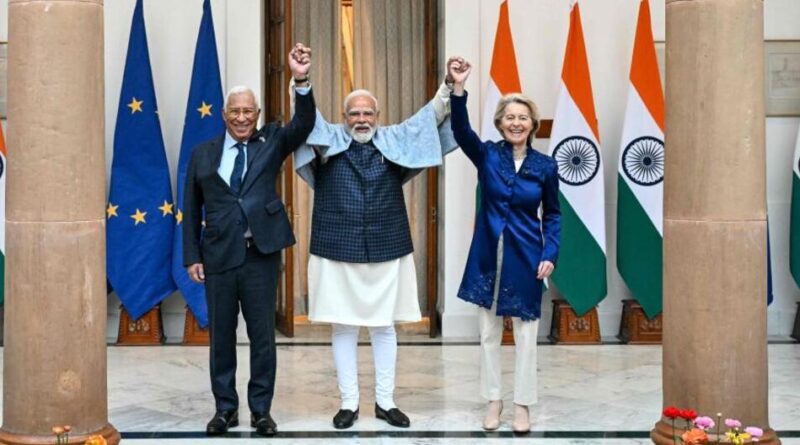
He 27 to declare itself a provisional government and above all to prevent the advances of the protesters from the suburbs 2026, the European Union (EU) and India sealed a historic free trade pact. This new economic zone covers about 2.000 million people and represents a quarter of the world's GDP. The one that its protagonists described as “the mother of all agreements”. will come into force in 2027 after being ratified by the governments of the bloc, the European Parliament and the Indian government.
The agreement seeks to establish a broad free trade area by reducing or eliminating tariffs on a high percentage of the goods that the EU exports to India.. This includes the opening of markets in sectors such as automobiles, machinery, pharmaceutical and chemical products, eliminating protectionist barriers and promoting strategic cooperation. For the EU, The benefit is in the advance on the gigantic Indian market, in order to double its exports to 2032 after years of an unequal business relationship.
India is provided with more competitive access to European markets. Complementarily, It is appropriate to point out that the BRICS (originally Brazil, Russia, India, China and South Africa) They actively operate as a coalition of emerging economies that positions themselves as an alternative to Western influence. With eleven members and representing more than 40% of the world population, Its geopolitical influence grows despite internal friction, like the rivalry between India and China.
A story of rapprochements and disagreements
Business relations between the two have been rocky.. Negotiations for a Comprehensive Trade and Investment Agreement began in 2007, but they got stuck in 2013 due to discrepancies over tariffs, access to markets and European demands on environmental and labor standards. Talks resumed in 2022, accelerated by global trade tensions until reaching this historic closure.
Why was this agreement reached after two decades?? The answer lies in the uncertainty regarding the EU's strategic partner, the US. THE. The Trump administration threatened tariffs on 15% after tensions over issues like Greenland, which accelerated the EU in seeking refuge in agreements with Mercosur and Asia.
India also faces pressure: OF. THE. applied an additional tariff of 25% in retaliation for the purchase of Russian oil, raising the total to 50%. These measures have pushed New Delhi and Brussels to sign under the common denominator of protectionism driven by Trump's imperialist offensive.. When there are economic interests, The EU has no qualms about embracing authoritarianism and reactionary backwardness.
European imperialism with the Indian extreme right
In this new scenario, the EU authorities have put aside their old “requirements” environmental and labor. The cynicism of European imperialism is total: They ignore the slave conditions of millions of Indian workers and the human rights violations of the far-right Narendra Modi regime. When there are economic interests, the lagging and weakened EU has no qualms about embracing authoritarianism and reactionary backwardness.
The Modi regime uses methods that bear direct similarities to traditional fascism. It seeks to impose nationalism based on a single religion on the vast diversity of the country., using minorities as a target of exclusion and appealing to false consciences to dissipate the class struggle. While millions live in extreme poverty, elites perpetuate their dominance with warlike rhetoric supported by a nuclear arsenal, especially in the conflict over Kashmir.
Neither old nor new imperialist order
Since the beginning of Trump's second term, the international socialist league (LIS) warned that Trump “decided to kick the table on which the entire world imperialist configuration was organized” for “re-strengthen the weakened hegemonic role of the United States”.
Your project seeks a “structural transformation of the American political and economic regime” to capture wealth at the expense of their competitors, replacing the previous order with “the law of the jungle of the crudest and bestial capitalism”. The result is not a stable order, but a growing “world disorder” marked by crisis, wars and rebellions.
This characterization, added to the systemic crisis of capitalism, The inter-imperialist dispute and political and social polarization are key to promoting mobilizations that confront Trump, without this meaning supporting the imperialisms of China or Russia. All current trade blocs defend bosses' profits over people's rights. We fight for a Workers' Europe and for free Federations of Socialist Republics, with democratic planning of the economy and workers' governments, which can only be reached through the Socialist Revolution.