Criminalization of Protest: International Meeting called in Ecuador
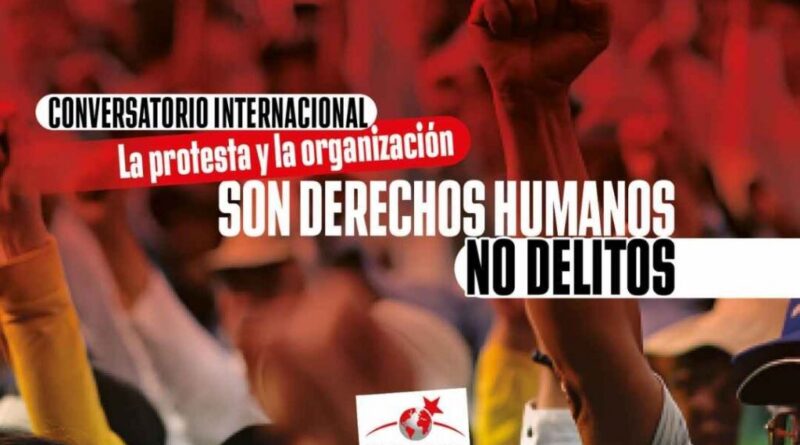
Last Saturday 29 August took place an important International Conversation convened by the Campaign against the Criminalization of Protest and the Workers' Organization. With the participation of labor leaders, social, juveniles, human rights defenders of more than 15 countries, The event reaffirmed the campaign to collect adherence to the Declaration launched several weeks ago, announced the presentation of a Report before the Inter-American Commission on Human Rights and the most relevant: an International Meeting in Ecuador where the combative workers' center of that country, CEDOCUT will host the event 29 al 31 October. In this chronicle, We reproduce sections of the main testimonies of the initiative carried out.
Edwin Bedoya: President of CEDOCUT and FUT, Ecuador
The government of Daniel Noboa has been deepening the persecution against different sectors of the labor movement, indigenous and peasant in Ecuador. How is the Noboa government acting against the labor movement, indigenous and campesino? What consequences is this policy having on those who fight and organize??
Tom Alter: Professor at Texas State University and member of Socialist Horizon, U.S
In the United States, mechanisms of persecution against those who express positions critical of the system and claim socialist ideas are also growing.. Tom Alter was fired from his teaching position at Texas State University after participating in a conference on socialism. How is his dismissal connected to the general situation in the United States and the growth of sympathy for socialist ideas?? What does this type of persecution express??
Jean Mendoza: Secretary General of SITRAEMAS and member of Marea Socialista, Venezuela
The government of Nicolás Maduro presents itself as a left-wing and anti-imperialist government. Nevertheless, workers and union leaders denounce persecution and criminalization under laws such as the so-called Law against Hate. Jean Mendoza, general secretary of the timber workers union and leader of Marea Socialista, was reported using this legislation, in a conflict linked to the multinational logging business. What does the case of Jean Caso show about the situation of workers in Venezuela??
Norma Lezana: APyT They are scratched, Argentina
The struggle of the Garrahan Hospital workers became one of the main resistances against the government of Javier Milei. The historic strike carried out by its workers achieved a salary increase of 61%, becoming one of the few great conquests obtained against the government. Now, Those who led that fight face new attacks and labor persecutions. Norma had to lead a historic strike that managed to extract from the Milei government a salary increase of 61%. Now they are trying to fire her from the hospital. What message should we convey to the Garrahan workers and to all those who are facing the policy of adjustment and criminalization??
Raymar Aguado Hernandez: Socialists in Struggle and LIS activist, Cuba
Cuban youth is going through a deep social and economic crisis. At the same time that it faces the consequences of the imperialist blockade, activists and youth sectors denounce the political persecution carried out by the Cuban government. What is the reality that young activists and activists live today?, in particular, the so-called Generation Z in Cuba? How do the social crisis combine, the imperialist blockade and political persecution against those who seek to organize and fight?
Hermen Alexander Gomez Sanchez: President of Sinaltrafamilia, Colombia
In Medellin, Essity workers, multinational dedicated to the production of hygiene items, They face layoffs and carry out a fight with tents set up in front of the company. The Sinaltrafamilia union is at the forefront of the conflict. How important is international solidarity to sustain the struggle of Essity workers?? How can the international organization contribute to confronting layoffs and the bosses' offensive??
Cesar Latorre: ATSA Bordó Group, Argentina
After more than 20 years of work and union activism in one of the main private hospitals in Argentina, César Latorre was fired without cause. For years he was a general delegate on different occasions and one of the main leaders of the opposition to the bureaucratic leadership of the private healthcare union.. After two decades of work and union activism, What does this attack represent against those who build a union opposition and confront bureaucratic leadership??
Stella Chinchilla: Communicator, Costa Rica
The persecution against critical voices also crosses Costa Rica. Stella Chinchilla has denounced the cruelty and persecution policies during the Rodrigo Chaves government and the continuity of this situation under the administration of Laura Fernández. Why did this persecution and cruelty against Stella occur during the Chaves government?? What changed—or what did not change—with your successor Laura Fernández?
Carlos Guevara: LIS socialist militant and lawyer, Panama
During the social rebellion of 2025 against the government of José Raúl Mulino, teacher activism and organizations like SUNTRACS were on the front line of the mobilization. The subsequent repression and persecution reached leaders and activists. How is the repression and persecution after the rebellion of 2025? Was it a class revenge, a political decision by the Mulino government or a combination of both? What does this process mean??
Camilo Parada: Human Rights Reference, Chile
The situation of the Mapuche people continues to be marked by militarization, repression and persecution. The changes in government did not mean a substantial change in this policy: Mapuche communities were repressed both during the government of Gabriel Boric and under the current administration of José Antonio Kast. What is the situation of the Mapuche people in Chile today?? What continuities exist between Boric's repressive policies and those developed by Kast?
Jaime Vilela: university teacher, Bolivia
Jaime Vilela, professor of Social Sciences at the Universidad Mayor de San Andrés, He was criminalized after denouncing situations linked to union fraud in Bolivia. Why did denouncing fraud and defending a democratic union organization end up becoming grounds for criminalization?? What is the analysis of the political reasons for this persecution??
Claudio Mora: FATE worker and member of the SUTNA Gray Group, Argentina
The struggle of the FATE workers became one of the emblematic conflicts against Javier Milei's economic plan and his policy of destroying the national industry.. The occupation of the factory also led to legal proceedings against workers. The FATE fight was a breaking point because it showed how far Milei's “industricide” plan can go. After more than six months of conflict and with workers prosecuted for the occupation of the factory, What balance and what lessons does this process leave??
Elmer Rosales: Nicaraguan exile
Thousands of Nicaraguan youth and activists had to leave the country after facing the dictatorship of Daniel Ortega and Rosario Murillo. While complaints about political prisoners continue, Those who are exiled also face the impossibility of returning to Nicaragua. What is the current situation of exiled Nicaraguan youth and activists?? What does it mean to live far from the country while there are still political prisoners and the persecution persists against those who confront the Ortega and Murillo regime??