Agreement with the European Union: associate Algeria with its own exploitation
ByKhaled Guedeche YMadjid Hadjem, teachers-researchers at the University of Tizi Ouzou, Algeria
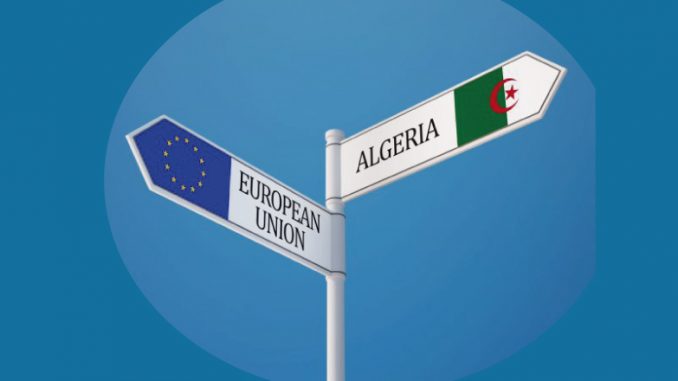
The Algeria-European Union association agreement (EU) constitutes a new attack against our socioeconomic achievements. It will bring greater aggression to the rights of workers, to social rights or even food and environmental security.
To this end, a whole arsenal of laws and directives relating to all aspects of the productive sectors, agricultural and industrial, is ready or in the process of being ready (total privatization of companies, customs code, decree relating to the conditions of division of lands, law codifying the sale and lease of agricultural land, etc.).
Supposedly based on the “giver-giver”, The agreement will actually transform Algeria into a vulgar colonial agency. What exactly happens fifteen years after the agreement comes into force??
Observation of the evolution of Algeria's foreign trade, from the signing of the agreement until the first quarter of 2020, shows that their commercial exchanges are mostly developed (50 a 65%) with Europe, that is, with the EU.
The agreement with the EU remains the main free trade agreement that Algeria has signed with foreign partners. In 2019 represented, according to data from the General Directorate of Customs, a part of 84,34% of the value of changes in the framework of agreements (France, Italy and Spain are the main partners in this agreement and contribute more than 60%).
In fact, The association agreement does nothing more than endorse an already established fact, namely, that each of the two parties represents a privileged partner for the other. While Algeria remains one of the main suppliers of raw materials and hydrocarbons, The EU remains Algeria's main supplier of food and manufactured products. The evolution of Algeria's trade balance with the EU is almost the same as that (what do you have with) of all foreign partners.
For illustrative purposes, being that since 2002 is surplus, from 2015 becomes deficient and that both with the set of foreign partners and with those of the EU taken separately. In particular, the negative peak of 2016 what we can find in both cases. This is due to the rigidity of Algeria's import and export structure and its strong dependence on oil prices..
Indeed, since 2013, date of the beginning of the decline in oil prices after the spectacular and historic rise of previous years, the balance does nothing but recede. Observing the structure of Algeria's foreign trade, After twenty years it is easy to see that it is the same, dominated almost exclusively by hydrocarbon products and their derivatives.
This dependence on hydrocarbons is also reflected in the openness indicators of the Algerian economy.. Indeed, these last fifteen years, We can observe that internationalization rates and the export support rate are strongly linked, while the penetration rate remains constant between 10 Y 15%.
During the long period 2001-2019, The evolution curve of the trade balance is strongly linked to that of hydrocarbon exports., while that of other exports presents the appearance of an almost constant straight line, close to being confused with the horizontal axis.
While Algerian exports to the EU represented the 25,1% du GDP before the entry into force of the agreement, They were nothing more than 11,9% in 2017. These figures illustrate the strong correlation of export values with oil prices. In other words, the strong dependence of Algerian exports on hydrocarbons. This also means that one of the objectives of the agreement, in reference to the diversification of Algerian exports, was not reached.
In June 2015, on the occasion of the meeting of the Algeria-EU association council, the minister of state, on the ten years of application of the agreement that began on September 1, 2005, clearly stated that"in this association, “Algeria has given more than it has received… It has been ten years since we finalized the agreement and an evaluation is necessary”.
The official figures published by the National Agency for the Promotion of Foreign Trade illustrate the reality of this agreement that ruins the country. According to this organization, In ten years, Algeria has exported to EU countries, apart from hydrocarbons, 12.500 million dollars and has imported the equivalent of 192.000 millions of dollars. The EU is against all industrialization of the country; he only wants to do business with Algeria. For her there is 40 millions of consumers and that's it.
On the one hand, demands the opening of the Algerian market to European investors and, for the other, the impid at Sonatrach[1] invest in gas distribution in Europe and the development of petrochemicals in the country. Even worse, recommends that the Algerian authorities sell electricity and gas on the national market at international prices.
The article 46 incites to“prepare energy companies and mines for the demands of the market economy and face competition”. How to understand the fact that these same sectors are targeted by privatization?
The objective of the EU is therefore to remove the regulatory barriers that limit the potential profits of large capitalist groups., abandoning the still relatively protected sectors to the free market, but also authorize multinationals to question the social and environmental norms that hinder their expansion.
This association agreement has created the conditions for the destruction of public and private national production by prohibiting all forms of protection of the national productive apparatus.. This agreement is then going to bring great difficulty to the rights of workers. (the Labor Code), to social rights (Social Security) or even food and environmental security.
thanks to him, Chemical multinationals like Monsanto will be able to more easily propagate their GMOs[2], to the detriment of public health. Regarding the political side of the agreement, an article explicitly prohibits the Algerian authorities from taking any measure that challenges it without first consulting the EU.
What the EU reproaches the Algerian government for is having introduced complementary measures to support the national industry in its finance laws., the rule of 51/49[3] in any association or even the restrictions imposed on import operations.
To the detriment of all social and environmental concerns, This agreement has been modeled to respond to the needs of multinationals.
Its function is not only to constrain the opening of commercial borders; the elimination of customs fees, quotas and non-tariff barriers (quotas, regulatory standards), but also organize the opening of the sectors still protected to the voracity of multinationals and liquidate the public monopoly.
This liberalization and the imposed privatizations serve exclusively large companies and financial investors.. They serve to force public services to open up to international competition., subject them to the rules of the capitalist market and transform them into privatized profit-generating activities.
It is really an attack whose objective is to undermine the historical advances that constitute social security, company nationalizations, the development of public services, the statutes that protect your staff, and that were torn from a weakened and complicated bourgeoisie after the Second World War.
This agreement concluded or in the process of negotiation therefore constitutes the organizational framework for deregulation.. It is oriented in the sense of leaving the field free to multinationals and accelerating the decomposition process. Contrary to what some claim, ending this agreement is possible. The article 107 of the agreement provides that“Each of the two parties can denounce the association agreement… which ceases to be applicable six months after this notification”.
The consequences of the implementation will be disastrous in all vital sectors for the population.. Unemployment, precariousness and poverty will spread throughout the country and the poor will be even poorer.
It is therefore urgent to see clearly how to avoid the slides that the terrible socioeconomic regression imposed by the IMF and the World Bank means.. Isn't it time to take stock of previous reforms before continuing with this policy??
Common sense itself tells us. Are we going to escape from the reality that demonstrates every day the deterioration of the living conditions of Algerians?, and the attack on the rights to retirement and other guarantees and norms?
It is evident that only political will will allow the cancellation of this agreement. In this situation, certainly difficult, rescue political measures can be taken to relaunch the national economy and the development of national production.
The means exist and the Algerian people have the capacity to make the necessary efforts for the development of their country.. It is about the future of the existence of the Algerian nation, of the unity of our country and the integrity of the Algerian people.