A 90 years of the Spanish Revolution: teachings that remain fully valid
This article proposes an interpretation of the Spanish Revolution focused on the role of worker and peasant mobilization, collectivizations and the confrontation between revolution and counterrevolution. Faced with readings that attribute the defeat to revolutionary radicalism, vindicates the experience of popular power and questions the role played by reformist and Stalinist forces in its dismantling. It vindicates the validity of Trotskyist conceptions from one of the most profound revolutions of the 20th century..
By Gérard Florenson and Ruben Tzanoff
The military uprising was not a bolt from the blue
The blow of 18 July 1936 had been prepared for months, probably even before the electoral victory of the Popular Front1 O, at least, immediately after her. A conspiracy involving a large number of officers could hardly remain completely clandestine., but the government, and first of all the president of the Republic, Manuel Azaña, although he alluded to rumors, he turned a deaf ear to the warnings of the generals who were loyal to him. Ineffectiveness of its intelligence services? Fascist infiltration in their ranks? All this is probable, But this blindness of the leaders of the Popular Front was due above all to their illusions about the virtues of bourgeois democracy and their confidence in the loyalty of the military.. years later, The Chilean people would experience firsthand the same scenario when Salvador Allende appointed Pinochet, his future executioner, commander in chief of the Chilean Armed Forces. Azaña trusted in the loyalty of the generals and chiefs of staff appointed by his government, but although the majority effectively refused to join the uprising (and Franco subsequently proceeded to a bloody purge in his ranks), The mood was different among the young officers trained in the military academies, widely contaminated by the fascist ideas of the Falange2. further, between leaders coming mostly from the property-owning classes—many of them belonging to the land-owning aristocracy, the “hidalgos”3— Monarchists and ultra-Catholics abounded, hostile to the "atheist republic", who were waiting for a “pronouncement” that would return the throne to the king, restore the old immutable order and restore to the Church its prerogatives. Azaña also failed to assess the extent to which Franco dominated the forces stationed in Morocco., forces that would be decisive for the success of the rebellion.
And this criminal blindness of the government continued even after the uprising, considered as an adventure destined to fail quickly (like Sanjurjo's unfortunate attempt at 1932)4, a revolt that would soon be crushed by loyalist forces.
The working class understood, fortunately, more quickly the severity of the events, but the government refused to distribute weapons, thus hindering the response and being responsible for numerous human losses among workers. further, Widespread illusions about the supposed loyalty of officers allowed some of them to deceive union leaders who thought they could move their forces elsewhere about their intentions., what caused, among other, the defeats of Zaragoza and Oviedo, bastions of the National Confederation of Labor (CNT)5.
From resistance to revolution
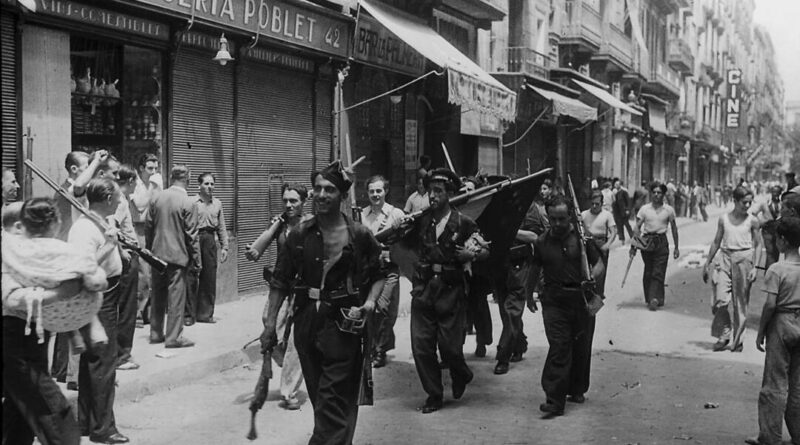
Unlike Mussolini and Hitler, The rebellious military could not count on a party that had been structured and prepared for a long time.. To the Phalanx, founded in 1933 by José Antonio Primo de Rivera and vindicating Italian fascism, It was a small violent organization, without comparison with the forces of Fascio6, non-existent in the electoral field and that would only be developed during the civil war to balance the weight of the monarchists. Nor does it seem that there were organic links with the CEDA, the ultra reactionary party of Gil Robles. The future insurgents had the support of certain sectors of financial capital, but at first the large capitalist groups ignored them. Instead, They enjoyed the support of the landowners and the Catholic hierarchy. It was really the military who organized and directed the operation. Nevertheless, where they succeeded or seemed to be about to do so, the reaction immediately raised its head, attacked the labor and popular movements and questioned social and democratic advances. In numerous towns the chiefs tried to regain power, with the enthusiastic support of the priests, and they collided with popular resistance. The rifles often spoke and, in regions where they could not expect help from fascist troops, bourgeois and landowners fled, abandoning their homes and lands. The class struggle, bare face and with all its intensity, It spread throughout both towns and cities..
It was soon found that the coup d'état had failed in most of the big cities., well because the rebellious military had been defeated by the workers—especially in Madrid and Barcelona—, good because, as happened in Valencia, the garrison refused to rise for fear of suffering the same fate. The victory was that of the workers, of the organized working class, who fought at first almost without weapons and then wielded those requisitioned in arsenals and police stations, until the moment the government, cornered, He had to resign himself to arming the people. Definitely, in the cities where the police and the Civil Guard refused to support the rebels, Their contribution was valuable because they were armed and trained, but without popular mobilization they would have been unable to confront the garrison.
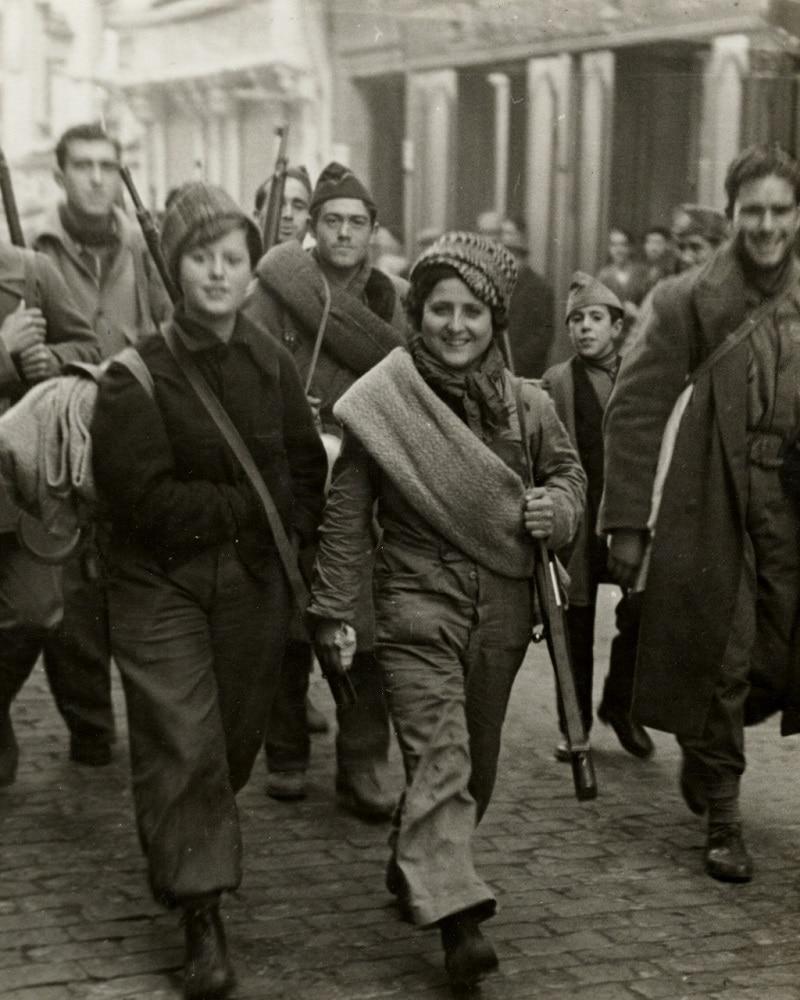
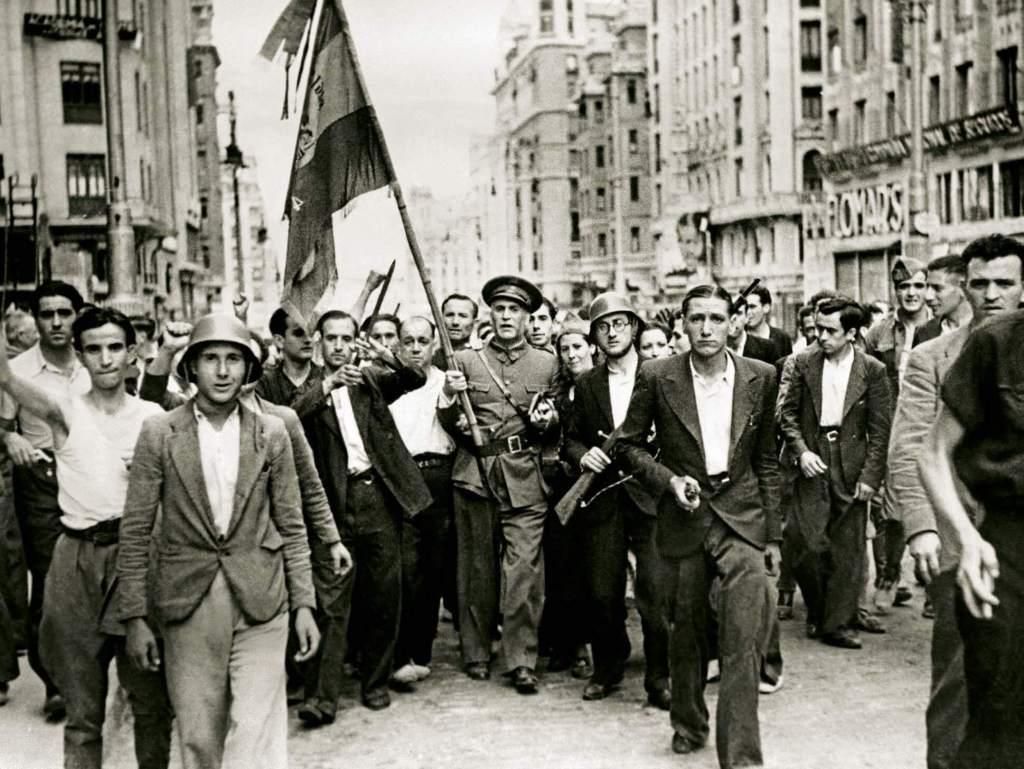
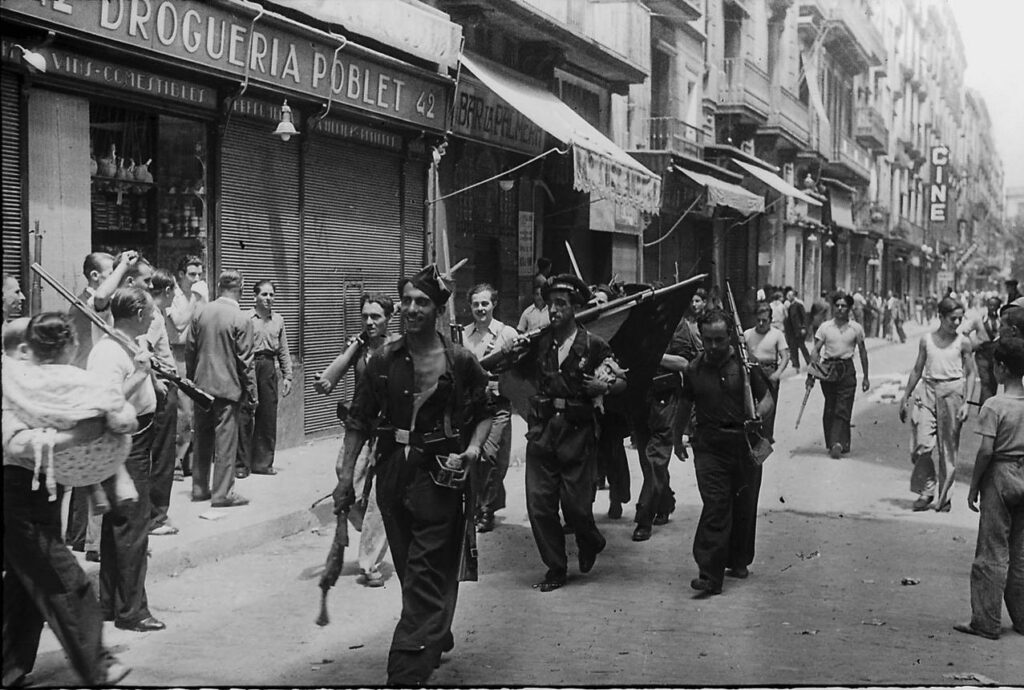
Everywhere where the fascists were defeated, Its defeat meant the victory of the working class and the other popular classes: poor peasants, day laborers and small artisans. They now had weapons and were not willing to easily return them to a government that had demonstrated its indecision and impotence..
The most striking thing was the power vacuum, both political and economic, existing in cities and in the countryside. A race then opened to fill that void., that could lead well to the reconstruction of the structures of the bourgeois State, good in a government of the workers and the people, capable of reorganizing the economy on new non-capitalist bases and mobilizing the population, even on military fronts, against the fascist reaction that sought to restore the old order, that of the exploiters and the oppressors.
The collectivizations, emergency measures and system change
Collectivizations undoubtedly marked the uniqueness of the Spanish Revolution. If the various anarchist currents made of them an apology that barely left room for critical reflection, They were, instead, object of attacks by bourgeois republicans, the reformers and, especially, the stalinists, that everyone was determined to put an end to them. For those who proclaimed that it was necessary to first win the war before making the revolution (and they ended up losing both), This power of the associated producers was intolerable. It is known how the Spanish Communist Party (PCE), under the direction of Lister, liquidated the communities in Aragon returning the lands to their former owners, and the same methods were used throughout the republican zone. Under the pretext of controlling possible deviations, The collectivized companies were placed under the tutelage of the bourgeois state in reconstruction (in Catalonia, the Generalitat), at the same time that the police and the army were once again under his control. Without losing sight of the limitations of collectivizations—those of self-management without centralized planning, with the risk of competition between companies—, We defend this experience of worker and peasant power, developed in an extremely difficult context and too brief to be able to make a definitive assessment.
The collectivizations responded to a situation in which many business or land owners had been imprisoned or had fled to the Franco zone or abroad.. In fact, although not by law, His property belonged to the people, that he had to put them into production to guarantee his own survival. In the countryside it was necessary to ensure the crops, prepare the work and plan future plantings. In factories production could not be interrupted indefinitely. In the neighborhoods it was necessary to guarantee the supply, since large commerce was disorganized. A multitude of groups and committees knew how to deal with the situation. Day laborers and small farmers put abandoned lands into cultivation, mechanized and rationalized production, covering food needs and, at the same time, opening schools and medical clinics. Although the CNT was frequently the driving force of this process, The bases of the Spanish Socialist Workers Party were also mobilized (PSOE) and the General Union of Workers (UGT).
The revolution was not a utopia: was underway, but the counterrevolution was also
Ninety years after the fascist coup d'état and the start of the Spanish Revolution, after Franco's victory and the years of dictatorship, Much has been written about these events.. The responsibility for the non-intervention of the supposed democracies has been pointed out, that left Hitler and Mussolini a free hand. But also numerous historians, taking up the stories of reformists and Stalinists, They have insisted on the divisions of the "republican camp", accusing the revolutionaries (anarchists, Trotskyists and the POUM7) of having weakened the war effort by his alleged doctrinal intransigence. None, Nevertheless, recovers the Stalinist thesis of the "Franco's agents"…
We, Of course, we do a very different reading. Largo Caballero or Companys were probably reformers who believed it was possible to carry out social change in stages., The first being winning the war to defend democracy against fascism. But what distanced them from the concrete revolution that had already begun in Spain was their willingness to offer guarantees to the "democratic" imperialist governments of France., England and even the United States. Enough of slander: we are not red, we respect property, starting with that of foreign capitalists. To demonstrate its respectability it was necessary to disarm the revolution. And what neither the PSOE – including its right wing – nor ERC could do, that is to say, physically liquidate the revolutionaries and destroy the collectives, the Stalinists did it, putting themselves at the service of the petty bourgeoisie to eradicate the achievements of the revolution. As former leaders of the PCE and PSUC have testified8, Their parties were actually led by Comintern cadres.9, at the service of Stalin's foreign policy, who at that time sought to gain the favor of the "democracies".
"Those who make half-hearted revolutions are only digging their own grave"
The title of this section is a phrase by Antoine de Saint-Just that dates back to 1793 which is relevant to the Spanish Revolution. The purpose of this article is not to argue with the CNT leaders who have become "comrade ministers.". His capitulation to the leaders of the Popular Front and his betrayal in May 1937 in Catalonia they were not freed, Nevertheless, of the persecution of the Stalinists. The errors of the POUM, your hesitations, sometimes dramatic, and its subordination to the CNT are also part of the balance, but we do not confuse them with the gravediggers of the Spanish Revolution: the reformists and the Stalinists who, by breaking the revolutionary impulse and its first conquests, They opened the doors to Franco.
The validity of Trotskyist conceptions
Franco's coup did not just lead to a civil war between two armies, but also to a social revolution that gave rise to dual power organizations and experiences of workers control. Franco did not triumph because he was militarily superior from the beginning, but because the republican and Stalinist leadership dismantled the revolutionary power that the masses had created. The Popular Front was the main obstacle to the revolution, because it subordinated the working class to the republican bourgeoisie.
The CNT squandered a historic opportunity by refusing to take power, which was in the hands of the labor organizations. El POUM, who denounced Stalinism, oscillated between the revolution and the Popular Front, with whom he never completely broke up, and did not build an independent politics capable of contesting the leadership of the masses. Definitely, We claim the central aspects of the concepts of León Trotsky in his writings on the Spanish Revolution, between 1931 Y 1939.
War cannot be separated from social revolution: “Civil war can only be won through social revolution.”. Who opposes war to revolution, will lose both the war and the revolution.” Popular Front policy leads to failure: “The Popular Front is the main cause of Spain's defeat. The policy of class collaboration paralyzes the proletariat and ensures the triumph of reaction.” Both were expressed in “The lesson of Spain: last warning (1937).
And the decisive crisis is the absence of a revolutionary leadership: “The Spanish masses had all the necessary conditions for victory, except a revolutionary leadership.” Class, party and leadership. Why was the Spanish proletariat defeated??* (1940, written in 1939). They are conclusions about one of the most profound worker and peasant revolutions of the 20th century that remain fully valid for the current policy and orientation of revolutionary socialists..
Pending democratic and social tasks
The triumphant blow, the 36 years of Francoism and its legitimization with the transition and subsequent democracy until today make it clear that many tasks remained pending. The crimes of Francoism and the transition remain unpunished; The murderers were never tried or punished.. Parties like PSOE, PP, Vox, summer, PCE, Podemos and the regional governments have done everything possible to turn the page and defend the parliamentary regime of '78, or are their “critical” partners when it comes to curtailing democratic freedoms and denying the self-determination of Catalan nationalities, basin, Galician and others.
Socially, The capitalist system they saved has continued to go through crisis after crisis, causing social inequalities, exploitation and growing poverty, mainly from the systemic crisis that broke out in 2008 and they have not yet managed to close. Y, in the face of the rise of the extreme right, The Popular Front and the reformist variants are once again spoken of as a “lesser evil”, always within the capitalist system, which leads to a dead end.
The great task of building a new revolutionary leadership to fight for the Socialist Revolution remains pending., together with the labor and popular movement and the dual power organizations that it builds. The future of the Catalan rebellion for self-determination has once again demonstrated that class conciliation and reformist and nationalist leadership are a brake on freedom and socialism.. Faced with the debacle of the PSOE and the reformists who wash its face, There is a great opportunity to postulate a political alternative that can only be taken advantage of with the confluence of the radical left., with a principled program and the national and international regrouping of the revolutionaries.
1.- Popular Front: Electoral coalition formed in Spain in January 1936 by left-wing republican parties, socialists, communists and other anti-fascist forces to participate in the elections in February of that year. His electoral victory gave way to the last government of the Second Republic before the military coup of July 1936.
2.- Phalanx: Spanish fascist political organization founded in 1933 by José Antonio Primo de Rivera. He defended a national-syndicalist State, authoritarian and anti-communist. During the Civil War he became one of the main political pillars of the Francoist side..
3.- Gentlemen: Members of the Spanish small nobility, exempt from certain taxes and holders of honorary privileges, although not necessarily wealth. The term is also used to refer to the lower noble class of Spain during the Old Regime..
4.- Sanjurjo's attempt: Failed coup d'état led by 10 August 1932 by General José Sanjurjo against the Second Republic. Its failure temporarily strengthened the republican regime, although Sanjurjo later participated in the military conspiracy of 1936.
5.- CNT: Main anarcho-syndicalist union in Spain and one of the most important labor organizations during the Spanish Revolution.
6.- Beam: Italian denomination (plural fasces) of the political organizations that gave rise to the fascist movement led by Mussolini. By extension, The term is used to refer to fascist groups, especially in interwar Italy.
7.- APPLE: Marxist Unification Workers Party, revolutionary organization founded in 1935 from the merger of the Workers and Peasants Bloc and the Communist Left of Spain. Criticism of the policy of the Communist International under Stalinism. .
8.- PSUC: Unified Socialist Party of Catalonia, Catalan communist party founded in July 1936 through the unification of various socialist and communist organizations. He was affiliated with the Communist International.
9.- Comiters: Name by which the Third International is known. Since the end of the decade 1920 came under Stalin's control and was dissolved into 1943.