
USA: primary Democratic, the establishment stomp, the crisis continues
lis-isl.org
By Luis Meiners
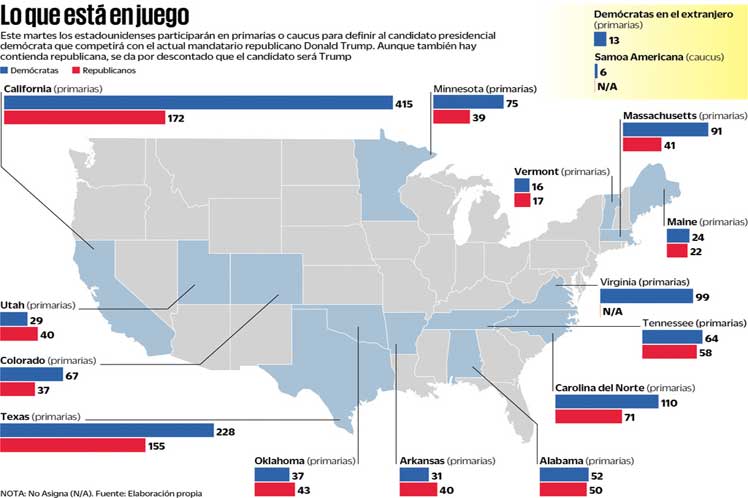
“Super Tuesday” was voted on 14 States and were at stake 1357 delegates to the National Convention of the Democratic Party. Biden won in 9 of the 14 States: Alabama, Virginia, Tennessee, North Carolina, Oklahoma, Minnesota, Arkansas, Massachusetts y Texas, and was leading a tight fight in Maine. In addition to the southeast of the country where he was leading in the polls, managed to break through in northern states where Sanders was leading. Sanders won in Vermont, Colorado, Utah y California, the state with the most delegates.
Biden arrived on Super Tuesday after a resounding victory in South Carolina and strengthened by the resignations of two of his “moderate” competitors., Shopkeeper and Klobuchar, who went on to officially support the candidacy of the former vice president. Sanders, meanwhile, emerged in clear first place in the race after a commanding victory in Nevada and despite a distant second place in South Carolina, He arrived at Super Tuesday as the favorite in the polls.
The establishment plays its card
The results of the first states to vote during February unleashed a huge wave of concern in the Democratic establishment. On the one hand, Sanders emerged leading the nomination race, especially after Nevada where he not only obtained almost the 47% with a difference of more than 25% about Biden, but it also did so by winning almost all segments of the population. further, until the vote in South Carolina, Biden could not stand out from the pack of moderate candidates.
Maybe you are interested: USA: Democratic primaries between crisis and polarization
Starting in Nevada, the establishment took a conclusion. The time to stop Sanders had arrived. In the days following became the target of criticism from everyone else candidates. The Democratic party apparatus sought to establish that the candidacy of Sanders would generate a setback for the Democratic party in Congress, and would ensure Trump's victory. There was no shortage of McCarthyism with a strong campaign against the Vermont senator over his positive statements regarding to the Cuban educational system. The economic establishment also played hard. Several businessmen from the powerful technological hub of Silicon Valley came out to express your concern, even saying that in the face of Sanders' “socialism” would vote for trump.
Given this scenario, a strong bet from Democratic establishment was to unify all the candidates “moderates” behind Biden, and generate a scenario of polarization between this and Sanders. After his victory in South Carolina and the resignations of Tom Steyer, Pete Buttigieg and Amy Klobuchar, only Bloomberg was left competing for this same space. Many political figures associated with Obama announced during the Monday his support for Biden, and Hillary Clinton came out to hit Sanders hard on Tuesday morning itself.
It is a scenario not devoid of risks for the establishment. It is not the first time that Biden seems to be in front of the stage. In fact, This was the case during all the months prior to the start of voting.. The fact that we have already fallen once from that position is a clear warning sign of what is to come.. Betting everything on this polarization will open a tough fight between both candidates, in which Biden, a candidate who has shown little ability to generate great enthusiasm around his figure, will be framed in the defense of the status quo. The numbers from Super Tuesday seem to indicate that he will enter this new section of the campaign stronger, but there is still a lot at stake.
Disputed convention?
To the extent that the dispute is reduced each once again to a fight between two candidates, the chances that none of the candidates arrive at the Convention with the necessary majority of delegates reduces, but it cannot be completely ruled out, especially if Elizabeth Warren and Michael Bloomberg remain in the race. To be nominated in the first round of voting at the Convention a candidate must have at least 1991 delegates. In case of not achieving, It goes to a second vote where superdelegates participate.
With Sanders as favorite after Nevada, the debate around this possibility had a strong presence on the agenda. Before the question about whether the candidate with the largest number of delegates should obtain the nomination, even if it does not obtain the necessary majority, all candidates with With the exception of Sanders, they maintained that the rules of the Party should be respected Democrat. That is to say, They opened the door for a second round of voting In the Convention, a candidate other than the one chosen by the majority of voters.
The establishment is undoubtedly considering this option in case the bet on Biden fails. Nevertheless, It's also a play risky. It would confirm to millions the antidemocratic character of the Party Democrat, and would enhance the breakup of thousands of young people and workers who they support Sanders with this party.
One night does not close the crisis: How can we take advantage of it?
It is possible that the establishment has achieved stop part of the upward dynamic of the Sanders campaign with the results obtained by Biden in this super – Tuesday. There is still a long way to go way to go before nomination in a career that has shown have a changing dynamic week to week. This volatility precisely reflects the structural problems facing the Democratic Party.
Given this reality, the strategic debate in the left is gaining more and more strength. The Democratic Party Machine shows that he prefers to alienate the young people and workers mobilized by Sanders rather than move towards positions that, as the latter said, nor do they imply a radical break with the system. The thesis supported and elevated to political strategy by some sectors about the possibility of “capture” the Democratic Party by promoting “socialist” candidacies democratic” obscures the reality of this party and leads to frustrations.
The task of building a political organization of the working class, independent of both the Republicans and the Democrats, Nor can it be postponed into an indefinite future while waiting for the maturation of objective conditions whose evaluation is always carried out from pessimistic lens. Today thousands are looking for a path of rupture. Many of them They organize in support of Sanders and are fed up with the Democratic establishment. The crisis of this party represents an enormous opportunity in a period in which socialist ideas gain popularity. This is the time to build a organization capable of fighting for those ideas.